A talk by Rachel Schurman, a professor of sociology from Minnesota, about her project “Science for the Poor: Foundations, Firms and the New Green Revolution for Africa” at 4:30 pm Monday, October 14, in PAC 001. Her website, http://www.soc.umn.edu/people/schurman_r.html.
@ Wes
FORUM: Government Shutdown
FORUM: Government Shutdown
Professor Logan Dancey, Department of Government
Professor Jennifer Smith, Department of Government
…will discuss the domestic and international implications of the recent Government shutdown
Thursday, October 10, 4:30 to 6:00 PM
Public Affairs Center 002
Free and open to the public
Colleagues on the Shutdown
Elvin Lim, Government:
On Shutdown Politics: Why it is Not the Constitution’s Fault
So it is not the Constitution that is at fault. It is faction, injected like a toxin into the Constitution, that has caused the separation of powers to go awry. And if so, the short-term solution for shutdown politics is to call faction what it is. Errant and arrogant members of Congress need to be reminded or educated that while they represent their constituents, some of whom no doubt want a stay on Obamacare, each member of Congress also belongs to a chamber of the United States and it is always the national majority (across the nation) that counts more than a factional majority (in a district).
Richard Grossman, Economics:
Republicans should take a lesson from history, which has shown time and time again that such ideological crusades, when applied to economic policy, can have disastrous consequences.
Magda Teter, Jewish Studies
During his marathon talk on the Senate floor, Sen. Ted Cruz, R-Texas, turned to history to help him persuade his colleagues to support his dream of defunding Obamacare, and quiet those saying that it was “impossible,” and “cannot be done.”
…
Sen. Cruz’s statements were not only outrageous. They were also inaccurate. Britain responded to the German invasion of Poland on Sept. 1, 1939 within hours, and Neville Chamberlain declared that the nation was at war with Germany by late morning the following day.
Help Organize a Conference on International Development!
PARTICIPATE IN ORGANIZING
WESLEYAN’S FIRST ANNUAL CONFERENCE ON INTERNATIONAL DEVELOPMENT
TO BE HELD IN THE
SEMESTER SPRING OF 2015
FRIDAY, OCT 4th,
USDAN 114 (ULLIAN MEETING ROOM)
4:30 pm
Confirm your attendance by emailing Chazelle Rhoden (crhoden- at – wesleyan.edu)
Alum’s Organization now has a blog
“The Watering Hole” is the new blog from Maji Safi Group, an organization founded by Wesleyan Alum Max Perel-Slater.
Advancing Leaders Fellowship Finalist: Max Perel-Slater
Former student is a finalist for this fellowship. He has a great project going on in Tanzania that a number of our former students have now been involved in. If you click on the link and “like”, “comment”, or “tweet” it you may help him win the social media element of the competition.
Advancing Leaders Fellowship Finalist: Max Perel-Slater.
And here is a link to the website for the organization he established, the Maji Safi Group.
Noted: AidData has updates
Update: AidData has a rejoinder to Brautigam. Available here and worth the read: http://blog.aiddata.org/2013/05/a-rejoinder-to-rubbery-numbers-on.html
An email I received yesterday has the following highlights:
Updated AidData Database: AidData
New China Aid Database: china.aiddata.org
However, Deborah Brautigam has some very, very important critiques of this database: “Rubbery Numbers on Chinese Aid”. For instance, she comments one of AidData’s papers based on their new data:
Table 2 in the paper provides a good example of the problems. It contains 20 Chinese “megadeals” totaling over US$38 billion. But only 6 of these 20 projects — less than a third — reflect actual deals (Ghana $3 bn CDB credit; Equatorial Guinea $2 bn credit; Angola Phase 1 $1.5 bn, CDB loan to Angola for agriculture $1.2 bn; Cameroon Memve’ele Dam $674 million; Nigeria light rail $673 million). That’s around $9 billion.
That said, I appreciate what AidData is trying to do here. Hopefully, they clean some of this up. My own sense is that each iteration of their general database gets better.
Here is their email:
Dear Colleague:
My name is Brad Parks. I am the Co-Executive Director of AidData, a research and innovation lab that tracks more than $5.5 trillion dollars from 90 donor agencies, creates decision support tools for development finance institutions, undertakes cutting-edge research on aid distribution and impact, and oversees efforts to geocode and crowdsource aid information.
Given some of your previous work, I thought you might be interested in a new dataset that AidData will soon release. At 4PM Eastern Standard Time on April 29th, at an event hosted by the Center for Global Development (CGD), AidData will release a dataset that tracks the known universe of Chinese official development finance flows to Africa from 2000 to 2011. The dataset relies on an innovative media-based data collection (MBDC) methodology, which has helped uncover nearly 1,700 Chinese-backed projects amounting to over $75 billion in official commitments. Our hope is that that publication of the data will provide a stronger empirical foundation for analyzing the nature, distribution, and impact of China’s overseas development finance activities in Africa. Along with the methodology and the dataset, several AidData and CGD staff and faculty affiliates are releasing a CGD Working Paper entitled China’s Development Finance to Africa: A Media-Based Approach to Data Collection.
Additionally, in the next 24 hours, we will launch a live, interactive database platform at china.aiddata.org that is accessible to journalists, researchers, policymakers, development practitioners, and the general public. The online interface not only makes it possible to filter, manipulate, and visualize the data, but also provides tools that enable users to vet and help improve the data. To enhance the accuracy of project-level data, the china.aiddata.org platform allows users to provide additional information about specific projects, such as media reports, documents, videos, and photographs, as well as suggest new projects not previously identified.
Please feel free to spread the word to colleagues who might be interested in this work. Also, if you would like to do something interesting with the data and blog your findings on The First Tranche (http://blog.aiddata.org/), let me know. We’d like to get as many people as possible to use — and potentially help us improve — the data.
Finally, if you are in the DC area on Monday afternoon and you are interested in attending the event at CGD, please register here. It starts at 4PM. I hope to see you there.
Best,
Brad
Brad Parks
Executive Director, AidData
The College of William and Mary
bcpark@wm.edu; bparks@aiddata.org
Ben Van Heuvelen, talk today: Oil, war, and the future of Iraq
You are invited to a talk
by
“Oil, war, and the future of Iraq”
Ben Van Heuvelen
Wednesday April 17, 2013
12.00-1.00 PAC 001
Ben Van Heuvelen is the managing editor of the Iraq Oil Report. His work has appeared in the Washington Post, Foreign Policy, The Atlantic, and Salon. He writes about Iraq, oil, and the geopolitics of energy; American foreign policy, politics and culture; and religion. He was formerly a research fellow at the New America Foundation.
Talk today: Lehoucq on Civil War in Central America
THE GOVERNMENT DEPARTMENT Invites you to a Public Lecture
“The Causes and Consequences of Civil War in Central America“ Fabrice Lehoucq Associate Professor of Political Science, University of North Carolina, Greensboro
Thursday, April 11, 2013
4:15 p.m. PAC 002
Professor Fabrice Lehoucq will speak today, Thursday, April 11, 2013, on “Causes and Consequences of Civil War in Central America.” The talk is at 4:15 PM in Public Affairs Center 002. It is co-sponsored by the Government Department and the Latin American Studies Program. Dr. Fabrice Lehoucq, associate professor of political science at the University of North Carolina, Greensboro, holds a PhD from Duke University. From 2001 to 2007 he taught at CIDE (Center for Research and Teaching in Economics) in Mexico City. In 2000-2001 he taught at Wesleyan. He is currently a visiting fellow at Kellogg Institute of International Studies at the University of Notre Dame. Professor Lehoucq is the author of The Politics of Modern Central America: Civil War, Democratization, and Underdevelopment (Cambridge University Press, 2012) and Stuffing the Ballot Box: Fraud, Reform, and Democratization in Costa Rica (with Ivan Molnar) (Cambridge University Press, 2002). He has been a consultant for the Bertelsmann Transformation Index, the Carter Center, the Inter-American Development Bank, the U.S. Agency for International Development, and the World Bank.
Co-sponsored by Government and Latin American Studies Program
African Feminisms – March 1 – An African Studies Cluster Event
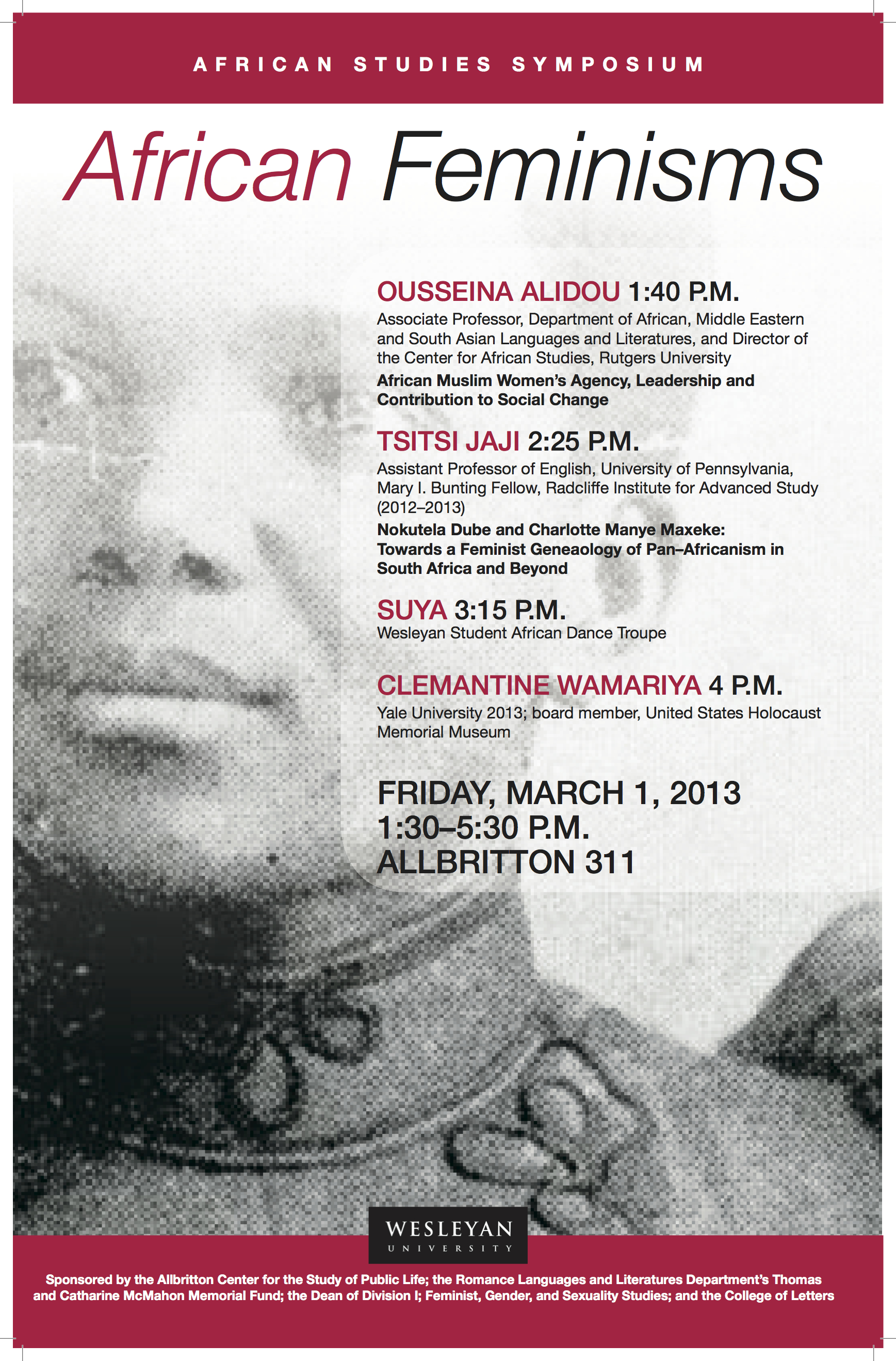
African Feminisms
The African Studies cluster symposium
March 1st, 2013, Allbritton 311
1:30pm: Welcome remarks
1:40pm: Ousseina Alidou, Associate Professor, Department of African, Middle Eastern and South Asian Languages and Literatures, and Director of the Center for African Studies, Rutgers University. “African Muslim Women’s Agency, Leadership and Contribution to Social Change.”
Followed by ten minutes Q&A
2:30pm: Tsitsi Jaji, Assistant Professor of English, University of Pennsylvania, Mary I. Bunting Fellow, Radcliffe Institute for Advanced Study (2012 – 2013). “Nokutela Dube and Charlotte Manye Maxeke: Towards a Feminist Geneaology of pan-Africanism in South Africa and beyond.”
Followed by ten minutes Q&A
3:15pm: SUYA: Wesleyan Student African Dance Team performance (including spoken introduction)
3: 45pm: Coffee break
4:00pm: Clemantine Wamariya, Yale 2013, board member, US Holocaust Museum
Followed by ten minutes Q&A4:45pm: Discussant comments
4:55pm: Final open discussion
 Michael Nelson