On Tuesday, Apr. 10, Kalpana Kochhar will speak on “The Life of an Economist at the IMF and World Bank”. She is the Chief Economist for the South Asia Region at the World Bank, and previously held a number of positions at the IMF. The talk is at 4:15 in PAC 001.
@ Wes
@Wes: The Brodigan Award, Apply Now!
Graduating seniors and recent alumni: don’t forget to apply for the Brodigan Award. The due date is April 6th. You can email your applications to me.
African Studies Cluster @ Wesleyan » Christopher Brodigan Award.
Visiting Professor Position Here at Wes!
The Department of Government at Wesleyan University invites applications for a position as Visiting Assistant Professor specializing in International Relations. This one-year, non-tenure-track appointment will begin August 2012 and is not renewable. Primary responsibilities will include teaching three undergraduate courses in the fall 2012, two undergraduate courses in the following spring, and supervising up to two senior theses. One course each semester will be an introductory course in IR. Another course will be International Security. This amounts to four preps. The other courses are subject to negotiation, but there will be a strong preference for courses with an international security theme. Candidates with an earned doctorate are preferred, but we will consider candidates who have achieved all-but-dissertation status. The successful candidate should have prior experience teaching his or her own courses.
To apply, please send a letter of application, a curriculum vita, three letters of recommendation, a brief statement outlining your teaching and research experience, and teaching evaluation statistics or other evidence of teaching effectiveness (but please do not send copies of individual student evaluations). The search committee will begin reviewing files as they are received and will continue work until the position is filled.
Wesleyan University is an Affirmative Action/Equal Opportunity Employer. Women and minorities are encouraged to apply. Please send all materials to:
http://careers.wesleyan.edu/applicants/Central?quickFind=51542
Today! The North Africa Spring
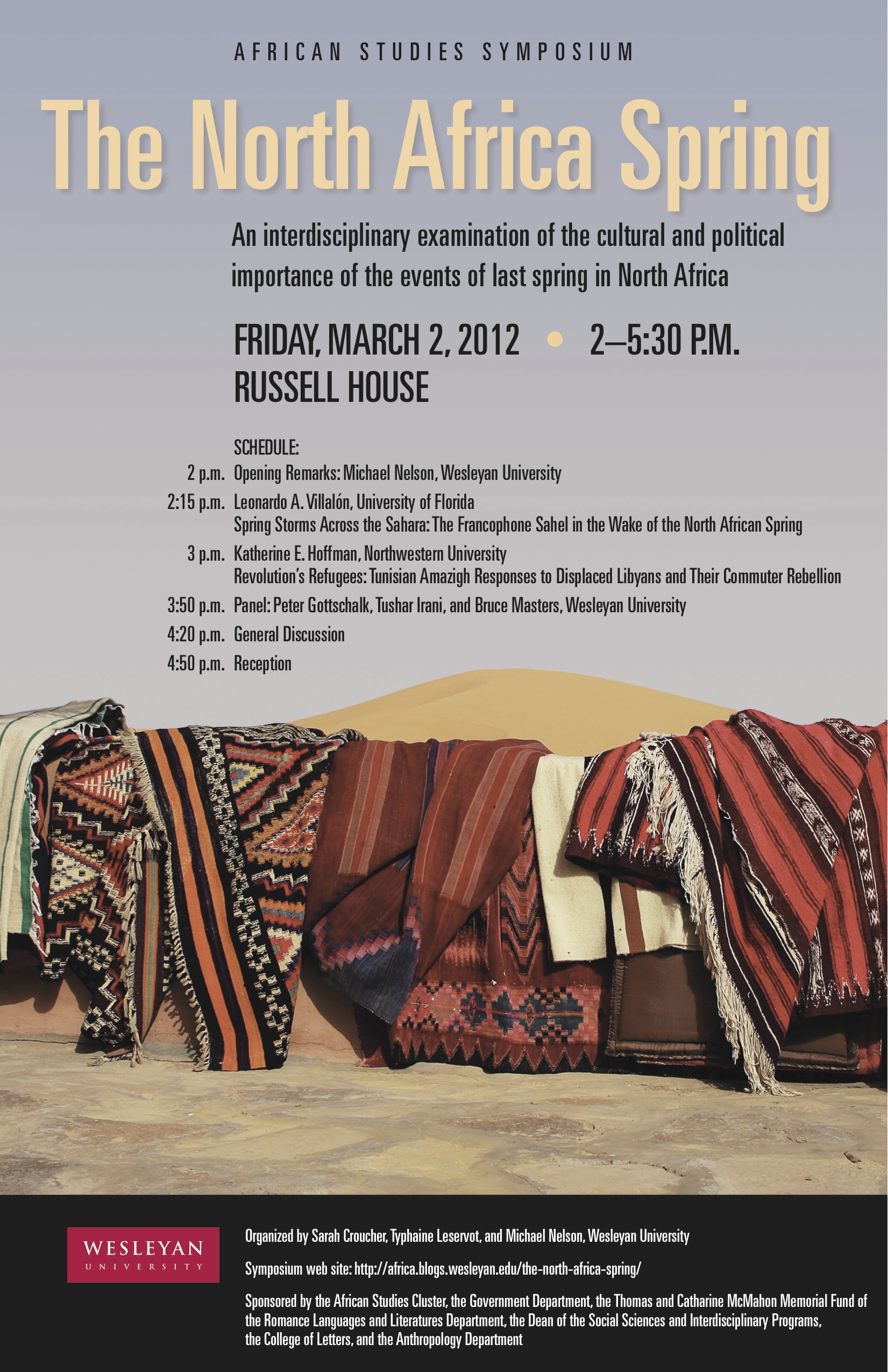
Download PDF Here: The North Africa Spring
Our Guest Speakers:
Katherine E. Hoffman, Associate Professor of Anthropology at Northwestern University, has worked for almost twenty years among Amazigh (Berber) populations in North Africa. She is currently researching in southern Tunisia and Western Libya on the role of Amazigh ethnicity in the integration of populations displaced by political violence into the country of first asylum. The project considers as well the surprising ways in which rural Tunisian community organizing in the South during their own revolution created networks that then allowed Tunisians to host, house, and feed hundreds of thousands of refugees fleeing violence in Libya outside the auspices of international relief organizations. Hoffman is the author of We Share Walls: Language, Land, and Gender in Berber Morocco (Blackwell-Wiley 2008) and journal articles in American Ethnologist, Contemporary Studies in Society and History, Ethnomusicology, and Language and Communication. She is co-editor (with S.G. Miller) of Berbers and Others: Beyond Tribe and Nation in the Maghrib (Indiana University Press 2010). Hoffman will be a Eurias Senior Fellow at the Institute for Advanced Study in Nantes during the 2012-2013 academic year where she will be working on her book manuscript Mirror of the Soul: Custom, Islam, and Legal Transformation under the French Protectorate of Morocco (1912-1956).
Leonardo A. Villalón is associate professor of Political Science and African Studies at the University of Florida. From 2002-2011 he served as director of the university’s Center for African Studies. He has published numerous works on religion and politics and on democratization in the Muslim countries of the African Sahel, where he has lived and traveled broadly over the past twenty years. He has taught for three years in Senegal, at the Université Cheikh Anta Diop in Dakar and the Université Gaston Berger in St. Louis. From 2001-2005, he served as president of the West African Research Association (WARA).
His current research focuses on religion and democracy in Senegal, Mali and Niger, as well as on social change and electoral dynamics across the Francophone Sahel. From 2007-09 he was named a Carnegie Scholar by the Carnegie Corporation of New York, for a project entitled: “Negotiating Democracy in Muslim Contexts: Political Liberalization and Religious Mobilization in the West African Sahel.” He is completing a book based on that research. With Mahaman Tidjani Alou of LASDEL (Niger) he directs a research project on religion and educational reform in the Sahel. He is also co-directing the two-year State Department funded “Trans-Saharan Elections Project,” focused on six countries: Senegal, Mauritania, Mali, Burkina Faso, Niger, and Chad.
Sponsors: The African Studies Cluster, the Government Department, the Thomas and Catharine McMahon Memorial Fund of the Romance Languages and Literatures Department, the Dean of the Social Sciences and Interdisciplinary Programs, the College of Letters, and the Anthropology Department
“Digging Together” Event @ Wes
On Saturday, Feb 25th:
Digging Together: Community Archaeology: Practice and Potential
Organized by my colleague and fellow Africanist, Sarah Croucher
Kingstone on Brazil: Feb 20 at 4:15
Event Today (Monday), February 20th at 4:15, PAC 002
Peter Kingstone (UConn) on “Democracy, Development, and the Puzzling Success of Brazil”
WES-FID: Commenting on SHOFCO
Tomorrow (Saturday, Feb 18) Wesleyan students are hosting a Forum on International Development. And I am very excited about this event! There are a number of reasons I think this will be a great event.
- It celebrates some of the fantastic things our students and alumni have done. This conference really just touches the tip of the iceberg in representing the projects our students have initiated and participate in.
- It is an opportunity to critically reflect on these projects and experiences.
- Students will learn from alumni that have been doing this for much longer and with great success.
- Students will learn from outside academics and experts.
I will never forget how, in my very first year teaching at Wesleyan, I was lucky enough to have several of the students participating tomorrow present in my introductory course. Both Kennedy Odede, founder of Shining Hope for Communities (SHOFCO), and Ali Chaudry, founder of Possibilities Pakistan, were in my classes. As was one of the organizers, Kathlyn Pattillo. And the next year Rachel Levenson, another of the primary conference organizers, also took that course. And I am probably missing the names of others involved in this event. It makes me think I should teach it more often!
I have been asked to moderate a panel discussing the work of Shofco. Besides Kennedy, both Nathan Mackenzie (representing Shofco) and Connor Brannen (Wesleyan ’10; current analyst at MIT’s Abdul Latif Jameel Poverty Action Lab) are former students of mine. Rema Hanna, a Professor of Public Policy at Harvard’s Kennedy School of Government will round out the panel. Our panel has been tasked with helping Shofco reflect on its development as an organization, its mechanism for evaluating its work, and the involvement of the Wesleyan community in the organization. While SHOFCO has had amazing success at attracting attention and funding in a relatively short time, I suspect the biggest questions will be about how they can build a sustainable program that stays true to its development objectives. This project represents a relatively rare collaboration between an activist in the developing world (Kennedy) and activists in the developed world (the Wesleyan community and especially Jessica Posner, yet another former student). That may be a key ingredient to their current success. But what will be important to sustaining this and how, at the end of the day, will we be able to measure their success?
@ Wes: 98 Students Present Data Analysis, Statistical Research
Our Quantitative Analysis Center has been a win-win for faculty and students. The core course is interdisciplinary and the results of that course are great:
 Michael Nelson