Africa Notes: Famous Africans, Kony 2012, and a Cocoa Map

Famous Africans
Nigerian President Goodluck Jonathan is on Time Magazine’s list of 100 Most Influential People in the World. Other Africans who made the list include: South African Paralympic medalist Oscar Pistorius, Egyptian Samira Ibrahim, Tunisian scholar-politician Rached Ghannouchi, and Gambian Fatou Bensouda, the new head of the International Criminal Court.

Kony 2012
Opinio Juris
has an interesting set online forum on “Kony 2012: The Social, the Media, and the Activism: Kony Meets World.”

The Cocoa Map
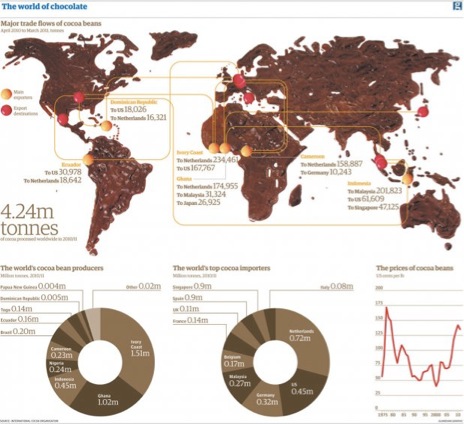
The Guardian’s “World of Chocolate” via Business Insider. Ghana and Cote d’Ivoire are the clear global leaders in production, but I must say I hadn’t realized how important Indonesia is to this market.
wpid-chocolate-map-2012-04-19-23-11.jpg

Africa Notes: Update on the Sudanese War

Updates (4/20): Uganda now says that it is prepared to help defend South Sudan in the case of invasion, which military analysts suggest makes that fight more than even (Washington Post). South Sudan is withdrawing from Heglig, the area I mention below (Times of India).

The conflict between Sudan and South Sudan is unfortunately developing rather quickly in a rather nasty direction. In my last post I suggested that South Sudan might have a claim to some of the moral high ground in the conflict, but recent events clearly muddy that picture. UN Secretary-General Ban Ki-moon has called South Sudan’s seizure of an oilfield “illegal”:

I call on South Sudan to immediately withdraw forces from Heglig. This is an infringement on the sovereignty of Sudan and a clearly illegal act (Reuters)

Meanwhile, Bashir is firing up his rhetorical machine. He reportedly told a rally:

These people [South Sudan] don’t understand, and we will give them the final lesson by force. We will not give them an inch of our country, and whoever extends his hand on Sudan, we will cut it. (Reuters)

Over at The Economist, they captured an even more worrisome quote:

We say that it [South Sudan’s leadership] has turned into a disease, a disease for us and for the South Sudanese citizens. The main goal should be liberation from these insects and to get rid of them once and for all, God willing

As The Economist notes, one hopes that this is mostly just talk but the fighting that has already gone on suggests it could be more than that.

Noted: Climate Change, Global Politics, and International Law

Earth Day is this Sunday and in both of my classes we are discussing the politics and international law of climate change this week and next. So I thought it might be a good opportunity to examine the recent news.

Fragmented Global Governance and Climate Change
A quick look at Reuter’s Diary on the Global Environment helps illustrate the continued fragmentary approach to these issues at the global level. Just in the next 7 days:

Regional Efforts
On a regional basis there is the Africa Carbon Forum, meeting in Addis Ababa; a “Public Forum on North America’s energy future” meeting in Canada; an “EU energy and the environment Minister’s meeting”.

Issue based efforts
Sweden’s “Stockholm+40” conference on sustainable development; The Fifth Annual Global Marine Renewable Energy Conference in Washington, DC

And if we look beyond the coming week, more of the same is happening in Asia, Europe, and elsewhere, looking at linkages between climate and water, climate and birds, the use of solar energy, and desertification. The meetings are hosted by governments, UN agencies, and regional organizations. On the one hand, we might like the fact that so much attention is being paid to these issues. On the other hand, how do we organize a response to climate change in light of such institutional complexity?

Individual state efforts to combat climate change may create problems for global talks
In Europe
While we wait on a global solution, individual countries are creating and implementing their own approaches to the issues. One example of this is a European Union law to charge airlines for their carbon emissions (Reuters). Reportedly, US airlines will comply, but China and India want nothing to do with this. Says India’s Environment Minister Jayanthi Natarajan:

For the environment ministry, for me, it is a deal-breaker because you simply cannot bring this into climate change discourse and disguise unilateral trade measures under climate change…
I strongly believe that as far as climate change discussions are concerned, this is unacceptable.

Apparently, India is suggesting that this culd be a reason for them to boycott all future climate-change talks.

In the United States
Recently, in the US there was a suggestion that the Endangered Species Act could be used to require the US to control greenhouse emissions. Since those emissions create conditions that make polar bear’s habitats less habitable, there was arguably potential scope for regulation. While this has so far been used to target domestic emissions, one can wonder whether a success in using the Act this way could also lead to pressures to regulate the actions of foreign actors whose emissions can be said to have direct effect on our polar bears’ habitats. My guess: highly improbable. But it is interesting.

Issue Linkage: Climate Change and Conservation

Finally, there is an interesting piece by Elias Ngalame at AlertNet on how Cameroon is trying to get support for climate adaptation projects in order to protect its elephants from poaching. The claim is that elephants are wandering out of the protected parks due to drought and desertification brought on by climate change, leaving them more susceptible to poaching.

Africa Notes: The Sudanese War

The news is bad. Sudan and South Sudan are, reportedly, now “locked in a logic of war” (BBC). The key disputes center on the still-disputed border regions where oil fields are present. (Map available here.)

Khartoum, unfortunately, seem to be moving along the path towards further conflict. Reports CapitalFm:

Omar al Bashir’s government says that will conscript all its citizens to fight in an all-out-war with South Sudan following an escalating oil conflict.
Sudan’s Ambassador to Kenya Kamal Ismail Saeed said on Tuesday Khartoum would sustain the war ‘at all costs’ until Juba withdraws its troops from a disputed oil field in Heglig.

AlJazeera has posted this report on how the Sudanese Parliament is now calling South Sudan the “enemy”.

South Sudan, for its part, claims that Sudan is violating the laws of war, using “indiscriminate bombing” in its attack on Heglig.

Overall, I get the sense that Sudan may be beginning to win the land war, but South Sudan may be earning broader support from its African neighbors and the international community.

Regional Dimension
There is, of course, an important regional dimension to this conflict. Two regional powers, Egypt and Kenya, have made bids to help resolve the feud diplomatically.

Thurston reports on Egypt’s roles here. As he notes, “It is not like Egypt has resolved all of its own internal uncertainties, so the fact that Egypt is making the Sudans such a high priority right now says that Egypt is quite concerned.” My view is that Egypt’s current situation also means that it is unlikely going to have the kind of impact that is needed to resolve the situation.

With the case of Kenya, objectivity may be the big obstacle to their playing a role as peace broker. Kenya has been a big winner with South Sudan’s independence. It is likely, for instance, that oil will soon flow from South Sudan to its port of Lamu (Reuters). But the recent conflict threatens both those economic interests and potentially Kenya’s broader influence in the region. As Thurston mentions at Sahel Blog, concerns about future refugees and associated humanitarian challenges are also relevant here.

Ethiopia… well, there really isn’t much news about Ethiopia’s government playing a role in any of this, though they are the host for the African Union’s efforts. Indeed, Ethiopia and Sudan seem to have their own border dispute issues (Sudan Tribune).

Efforts by the African Union, including talks held since in July in Ethiopia’s capital, Addis Ababa, have also failed thus far. As one security analyst notes: “Thabo Mbeki [former South African president who is leading the mediation] and his panel are losing their edge” (The Star).

The International Community
I am still not very clear on what roles China is currently playing in all of this. Ever since secession was clearly going to happen, China has actively courted South Sudan’s leaders. South Sudan’s President Kiir is due to make a state visit there within the next few weeks (Reuters).

As for the United Nations, no clear policy for dealing with the situation has emerged yet. Secretary General Ban Ki-Moon is making the basic pleas for peace. And the Security Council is hearing reports on the issue. One option on the table is sanctions (Reuters).

But we are all waiting.

Africa Notes: Ngozi Okonjo-Iweala: not an American, but an African, and a woman

Ngozi Okonjo-Iweala: A Missed Opportunity?
I meant to comment on this last week, before it became a moot point. But yesterday, the World Bank selected Obama’s nominee, Jim Yong Kim, as its new President (Business Insider). This should come as no surprise, as the US has always had its choice selected. And I am personally hopeful that he will do a good job.

Not an American
Nevertheless, it is still worthwhile to consider the significance of Ngozi’s candidacy. As Drezner noted, the rhetoric surrounding this reached a surprising level and for the first time the World Bank’s board did consider her in additional to the US candidate. Consider noted realist Stephen Walt’s mention of this as a “missed opportunity” for the US. He has interesting take on what the “smart” realist position should have been here:

Of course, realists expect powerful states to use international institutions to advance their own interests, which is why they want to make sure that the people in charge are reliable. If I were president, I would want the World Bank to be led by a highly competent individual who wasn’t about to harm U.S. interests. But a smart realist would also recognize that imposing the U.S. choice on others every single time is bound to trigger resentment, and encourage rising powers like China, Brazil, India, and others to redouble efforts to break Washington’s stranglehold. And every time the United States has to twist arms or use its privileged position to get its way, other states quietly seethe and anti-American forces are handed another nice talking point to use to undermine the U.S. image around the world.

But an African
Over at Global Voices, they bring the attention back to Ngozi herself, wondering whether the campaign was only symbolic.
Ngozi herself was very graceful in her concession to Dr. Kim. But she also noted that she saw this as a significant effort to reform an old institution. From her Facebook page:

by our participation we have won important victories. We have shown what is possible. Our credible and merit-based challenge to a long-standing and unfair tradition will ensure that the process of choosing a World Bank president will never be the same again. The struggle for greater equity and fairness has reached a critical point and the hands of the clock cannot be turned back.

And a Woman
So the dominant meme above is about the World Bank, the institutional reform that might be needed there, and concerns about North-South relations. We also hear online about how this was “a victory for Africa”. But it should not be missed that here we have a strong African WOMAN who played a key role in the political drama. Forbes recently listed her as the 87th most powerful women in the world. Had she secured the World Bank bid, I am certain she would have risen quite quickly in their rankings. She has a history of activism on the part of African women, s described over at the International Women’s Health Coalition. There she describes her “community” approach to supporting women’s rights:

In the early 1980s I got involved with Women in Nigeria (WIN), which was a women’s rights activist group and feminist organization with men members as well. I was one of the founding members of WIN, I started the Kano state branch, and in the mid 1980s I was the national coordinating secretary. But even at that time I felt that focusing on women alone would never bring about the kind of radical transformation of the conditions of womanhood that we envisioned for Nigeria—whether we were talking about patriarchy, or our relationships with men, or our ability to exercise our reproductive rights, or even our ability to attain reproductive health. Focusing on women or on one single issue was not going to do it—we needed to work with men and young people and women together. So, I felt that only by taking a community perspective could we create the sociocultural environment necessary for her to assert or express her full personhood as a woman.

Since those earlier days, she has risen to be a major force in Nigerian politics (the Finance Minister), and had a successful career with the World Bank, including being Managing Director prior to her current job in Nigeria. In Nigeria, her biggest battles have been against corruption. A brief recent biography at The Economist helps highlight how brave she truly is:

Death threats are no rarity, and the barrage of abuse from the national press and in online forums is continuous. Often referred to as Okonjo-“Wahala”, meaning “trouble” in pidgin, she does not tiptoe around. “If vested interests, benefiting from corruption, are attacking left, right and centre, then you are doing something right. The degree of attack is a barometer,” she says.

One of my favorite TED videos, which I often show to students, is her presentation on why Africans should accept aid. The pertinent bit begins at about 6:40, when she states:

African states have been giving the other countries aid… The UK and the US could not have been built today without Africa’s aid. It is all the resources that were taken from Africa — including human — that built these countries today.

This is a strong woman who would have been able to play an important role as head of the World Bank. But at 57 years of age, maybe this wasn’t her last chance?

See also The Guardian’s profile on Ngozi.

Africa Notes: Mali Update

Update: Just saw this link to a nice timeline of the conflict in northern Mali since 1891 on IRIN. (h/t Sahel Blog).

Things still look rather grim in Mali, though the situation is in constant flux. It might be useful to look at the situation from different vantage points:

The people of Mali
It is probably no surprise that in coups and wars much is done in the names of various peoples, but at least in the short-term, the peoples of Mali seem poised to suffer. While County and Peterson find that some in Mali may welcome the coup as an opportunity to introduce democratic reform, as Bonicelli suggests at Foreign Policy, the lessons for the impatient citizens in Mali might be the wrong one. Coups should not be normalized as a way to bring about democratic change.

Also unfortunate for the Mali people, and perhaps most immediately threatening, is a looming famine crisis.

And violence + famine = refugees here. The largest group outside of Mali is apparently in Mauritania (48,033) but at least 100,000 are internally displaced and others have fled to Burkina Faso, Niger, and elsewhere in West Africa. (IRIN)

The Azawad State
The rebels want their own state and even have a name for it (see Thurston’s comments at Sahel Blog). But what does it take to create a new state? What is required for secession to count? Lesley Warner’s take is that the Azawad rebels have “not been able to check the necessary boxes for international support” (h/t Sahel Blog). Indeed, ultimately statehood does rely on international recognition. So far, they seem quite far from getting it.

Over at Wronging Rights, they add a little more depth, citing the only document we have on what a state is, the 1933 Montevideo Convention on the Rights and Duties of States.

The Government of Mali
The coup leaders did step down. But the new interim President, Dioncounda Traore, does not seem to want to keep things calm. As has been wildly reported, he is threatening “total war” on the rebels in the north.

West Africa
West Africa has a strong tradition of tending to its own political crises, via African mediators and its own unique regional organization, ECOWAS. All of this is happening here. President Compaoré (Burkina Faso), opened talks on Saturday between Mali’s politicians and military. Notably absent: the Tuaregs.

Meanwhile, ECOWAS’ Mediation and Security Council recommended a regional force be deployed should mediation by President Compaoré fail. However, that force is not intended to deal with the coup so much as it is to deal with the rebels in the northern part of Mali. This is an important sign that the Azawad state lacks the regional allies it would need.

The International Community
The French are clear about their interests. Sarkozy:

…we must do everything to prevent the establishment of a terrorist or Islamic state in the heart of the Sahel. (Reuters)

Gregory Mann notes that in Paris, however, there are lots of views on the streets about the events in Mali (“Bamako-sur-Seine”).

Also, UNESCO is worried about the cultural treasures of Timbuktu.

And So…
And so things continue to move. I shouldn’t try to predict but… my best bet is that we will see a gradual return to constitutional rule in the southern part of the country followed by a slow and torturous attempt to regain control of the north. ECOWAS will play a key role in this and a year from now we will barely hear anything more about it. But I really hope I am wrong about the torturous bit. I would much prefer that this become an opportunity for national dialog about how to better serve the needs of the Tuareg populations in the north.

Africa Notes: Now that Timbuktu has been taken, will more of us pay attention?

The crisis continues to unfold in Mali. And maybe the coup leaders are seeing that EVERYTHING is going against them.On Saturday the pledged a quick power handover.

  • First, the coup leaders are increasingly unpopular in West Africa.
  • Uncertainty is the word Camilla Toulmin used to described the situation.
  • The view from the West
    • The UK tells its citizens to leave.
    • Walter Russell Mead continues in his Afro-pessimist vein in describing the situation. As he says, the Financial Times described Mali as “one of west Africa’s most stable countries”. So, he tells us, “This casts serious doubt on the mainstream press, NGO and foreign policy establishment line on Africa.”
  • Meanwhile, the average Malian is in for some major problems.
    • As Baz Lecocq notes, the hot season is starting in Mali and food is going to be a big issue. What is more, he suggests, the Malian army is not prepared to handle the heat of the hot season in the extreme parts of the country the rebels currently hold.
    • Oxfam has this press release on food shortages (here) (via Sahel Blog)
  • And the Mali army is losing more and more ground to the rebels. I am certain by now they must realize that former President Toure likely did not have any more resources to give them before the coup. Perhaps that was why he already was willing to step down on his own.
    • So they lost the northern town of Kidal.
    • And rebels reportedly entered and then took Gao. (and here)
    • And then on Sunday (today) they apparently surrounded Timbuktu and then planted their flag there.. Which is probably the only city most Americans have heard of. So we might finally start to see greater press attention.

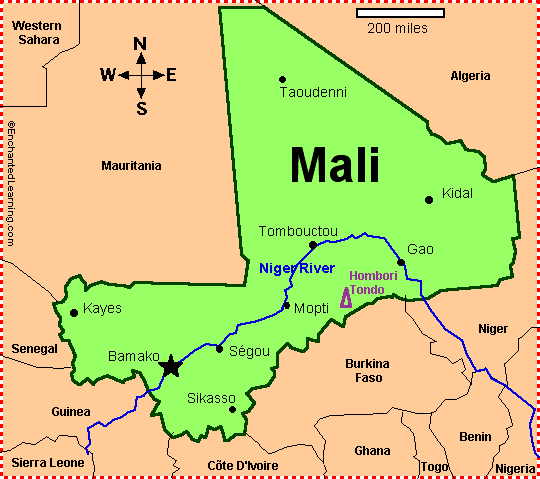
    If you examine this map of Mali (via Wars in the World), you can quickly see how rebel advances place them in control of a large swath of territory. Indeed, draw a line between Gao and Timbuktu, extend it, and you will see about half the country in rebel hands. Of course, it is the less-populated, poorer half. But it is very significant.

Noted: More reactions on the Mali Coup

First, an interesting point that is often not stressed enough in the news reports on the coup: President Toure wasn’t even running in the April presidential elections. He already planned to step down. So why be impatient?

Indeed, Gregory Mann seems appropriately skeptical of the coup leaders’ lofty goals for fighting corruption and promoting democracy (Africa is a Country). Brian Peterson finds a lesson in all of this: African leaders should take grievances seriously (African Arguments). I actually was unaware of the “war widow” protests in January that he mentions.

Meanwhile, our understanding of the potential routes forward continues to develop. First, the immediate consequences of the coup are still being sorted out. The US has joined other states in suspending aid to Mali (Reuters). Meanwhile, Tuareg rebels are reportedly advancing further into Mali (The New Yorker). Thinking more about the long term, Alex Thurston usefully considers whether past West African coups have lessons for Mali (Sahel Blog). I think his fourth point, “coup leaders who cause chaos are overthrown in coups”, might be prescient.

Africa Notes: The Mali Coup

The recent coup in Mali is an important setback for Sahelian democracy. And the situation there is still fluid, as reports of a counter-coup (which may just be a rumor)surfaced today.

Here are some of the themes that are emerging:

Coup Causes

1. The North Africa Spring. As I hinted last week, we can trace back the recent coup–at least partly–to the events of the North Africa spring. The military officers who took over stated very explicitly that one of their reasons for their actions. Meanwhile, Afro-pessimist Walter Russell Mead has already used this as an opportunity to critique NATO intervention in Libya.

2. The military’s specific discontent with the government. Over at Baobab at The Economist, they mention the events most proximate to the coup:

The spark for the mutiny came during a visit to Bamako’s main barracks by Mali’s defence minister. For weeks, discontent has been building as ethnic Tuareg rebels—flush with heavy weaponry stolen from Libya, and better organised than at any time in the past—have launched a series of attacks, sacking beleaguered garrisons and inflicting heavy casualties on the demoralised Malian army.
When the minister failed to assuage soldiers’ concerns that the government had a grip on the insurgency, troops fired angrily into the air. Hours later they swept into Bamako, stormed the state broadcaster’s offices and laid siege to the presidential palace. A thousand miles to the northeast, junior soldiers placed their superiors under lock and key.

3. Was this an accident? Think Africa Press has questioned whether any of this might even be “accidental”. (h/t SahelBlog).

4. General dissatisfaction with the President. Some in Mali doubted the President’s commitment to overseeing free and fair elections this April and he is alleged to be involved in cocaine trafficking and a number of corrupt business deals. (Sources: Tesfay)

Coup Consequences

1. Mali is losing aid money. TheWorld Bank and African Development Fund suspended funds. The EU was next. The US has only issued threats about withdrawing aid thus far. Mali, of course, has been a key strategic partner in American efforts to counter Al Qaeda in the Maghreb (AQIM). Also, while (now former) President Toure was an important part of that alliance, there are reports that one or more of the leaders of the coup received American training.

2. Delay in national elections. The elections were due next month but now no one knows when they may take place. ECOWAS has suggested they go on with the elections as planned, but that is way too optimistic. While the coup leaders say they will restore democracy, Mali historian Gregory Mann, at least, thinks that the coup was “not intended to secure democracy, but to prevent it”. (Sources: Tesfay, Gregory Mann, Reuters).
        [The Africa Report has a nice rundown on who the possible candidates for the election were prior to the coup.]

3. Greater “terrorism” risks. That is the phrase some have used. But as Townsend argues at African Arguments, it is likely that this coup will make it harder, not easier, to solve Mali’s “Tuareg Problem” (Sources: Tesfay, Townsend)

4. Greater risks for (especially) foreign enterprises. Tesfay at Executive Analysis argues that mining taxes and even expropriation might be a risk for a number of businesses operating in Mali.

5. Worse military-society relations. Not only was the public stunned by the military’s actions, but the military also apparently were involved in looting in the aftermath of the coup.

However, there are some optimists out there. Over at The Monkey Cage, Erik Voeten notes research showing that “since the end of the Cold War most coups are quickly followed by competitive elections and a restoration of democracy.”

We’ll see.

Africa Notes: Seeing Kony, Part 2: A timeline

I have resisted posting more about “Kony 2012” since my first post. There has just been so much going on, though it has started to calm down, as the graph of Google searches shows:

To organize my own thoughts about this I thought it would be useful to construct a timeline of some of the major (and minor) stories associated with Kony 2012. This is not intended to be comprehensive (I don’t have the time) but mostly reflects postings on blogs and news websites that I frequent. My main thoughts:

1. This is a great teaching moment.

2. This highlights important challenges for American-based NGOs and advocacy groups doing work in Africa. On the one hand, it is not a bad thing to want to do “good” in the world. On the other, it is tricky to know what it means to do “good”. On balance, I think the intentions of Invisible Children are fine, often laudable. I sincerely doubt that they overtly want the kinds of imperialism and militarization of US foreign policy that there critics suggest they want. But unfortunately that doesn’t mean that their message and their agenda doesn’t have some important flaws.

3. It is hard to insert nuance into propaganda. I do believe that Russell and others at Invisible Children know more about what is going on with the LRA than many critics give them credit for. But video pieces like Kony 2012 don’t do enough to show that. Perhaps they should try to do a “real” documentary?

4. In the age of the internet, it may not matter what your intended audience is. If this had only been shown at college and high school events in the US (the intended audience) it would have had a different reception than it did being shown globally.

The timeline

March 5: Invisible Children releases the video

March 7: Reactions come trickling in.

Joshua Keating provides one of the first and frequently cited reactions to Kony 2012: “Joseph Kony is not in Uganda (and other complicated things)”.

March 8: Video has at least 38 million views; critics of the video sound out

Michael Deibert on March 8 stated one of the enduring criticisms of the message of the Kony 2012 campaign early on:

The problem with Invisible Children’s whitewashing of the role of the government of Uganda’s president Yoweri Museveni in the violence of Central Africa is that it gives Museveni and company a free pass.

Christine M. Rose at GhanaBlogging:

Overall, my concern is that although awareness can be an incredibly beneficial boost for a campaign, by itself it doesn’t do anything. Furthermore, it sometimes serves to absolve people from any further effort, including taking the time to actually understand the issue, including its root causes. Reposting a video on facebook is incredibly easy. Throwing red and black posters all over the place and wearing awareness bracelets is easy (look at livestrong.) Even donating money is relatively easy. Facing up to the complex and myriad factors that have contributed to this problem is much harder,

Rosebelle, a Ugandan blogger, was heavily cited for her video response to the Kony 2012 campaign.

Bloggers at Wronging Rights begin a seriesof public media events that show how they are “Kony 2012 skeptics.”

March 10: the range of perspectives, and responses to the criticisms, expands. Many see this as a teaching opportunity.

Kony 2012 Director responds to critics

Criticism
Teju Cole blogs on American sentimentality towards Africa, in Twitter form:

5- The White Savior Industrial Complex is not about justice. It is about having a big emotional experience that validates privilege.

Qualified Approval
Chris Blattman, who has criticized some of Invisible Children’s earlier campaigns, comes out to provide heavily qualified approval for their campaign.

But, mostly amazement at how big a phenomenon this became.
As Duncan Green blogged, “why did it get 60 million hits?”

And teachers begin to try to think about how they can use this as a teaching opportunity
See Tiemessen on the Duck of Minerva: Bandwagon Empowerment
See also a later post by Charli Carpenter on “The Kony 2012 Experiment”

March 13

Ethan “unpacks” Kony 2012.

Jason Mogus digs deeper into the success of Kony 2012:

IC knew who its audience was, simply, American youth. It speaks in their language, using their cultural heros and influencers. Everything in KONY 2012 from the visuals (Facebook, hip posters) to the tone (hopeful, not dour or depressing) to the emotional hooks (kids, the power of people to tip the world, social media) speaks directly to this audience. Maybe this is one reason why it annoyed so many “institutional experts” over 40!

David Kenner compares Kony to Syria’s President Bashar al-Assad.

March 14: More Ugandan perspectives, criticism

The video is shown to Ugandans. (The Guardian reports). At Al Jazeera, they stress “angry” reactions by Ugandans to the video.

Also at FP, Betty Bigombe, State Minister for Northern Uganda, responds to some interview questions.

It’s coming rather late, and I’m not quite able to understand the objective. Is it fundraising? Is it awareness creation?

So with this kind of campaign, [Kony 2012], I do not know whether it makes any difference as far as taking him out is concerned. However, what is important is bringing this to the attention of policymakers. I hope that something innovative will come out of it.

The criticism continues to build:
Sverker Finnstrom, a cultural anthropologist and Uganda specialist:

A most prominent feature of the Invisible Children lobby is the making and constant remaking of a master narrative; it reduces, depoliticizes and dehistoricizes a murky reality of globalized war into a completely black-and-white story pitting the modern Ugandan government and its international partners in development who defend the noncombatant citizenry against the barbarian Lord’s Resistance Army

David Rieff, at Foreign Policy, calls the film “dangerous progaganda”.

March 15

Criticism of howInvisible Children’s finances work hit the web.

March 16: A rebuttal from IC; parodies

One of the best rebuttals to the critiques comes via Foreign Policy by Adam Finck. Indeed, one of the most popular criticisms of the video is that it misleads us into thinking the LRA are still in uganda, but as Adam points out:

Kony 2012 does portray the LRA’s movement away from Uganda into the DRC, the Central African Republic (CAR), and South Sudan (minute 15:01), and a quick look at the LRA Crisis Tracker leaves no doubt about the LRA’s current area of operation.

As I pointed out in my earlier post, it is notable that IC has created this crisis tracker tool. And it just goes to underscore how the Kony 2012 video was intended for a limited audience (young Americans) as a publicity piece.

Parodies

Some of the critique, in my opinion, go a bit overboard, like this comedic one from The Juice Media (h/t Global Voices).

Global Voices has a number of other parody videos over at their blog as well, including some starring Hitler.

March 17: Things begin to go wrong in a bad, weird way for IC

Invisible Children Co-Founder Jason Russell arrested for doing some strange things in public. We now know he had a sort of stress-induced breakdown and it is expected that it will take some time for him to recover. He has a family and there is no reason for criticisms of IC to involve criticisms of him.

March 18: The Ugandan government responds with its own video

Here is Ugandan Prime Minister Mbabazi on YouTube:

The PM does a nice job providing a balanced view on the video, praising the good work of the IC:

it has been inspiring for me…. to be reminded of the innate goodness that exists at the heart of humanity…

But also correcting some of the misperceptions of Uganda that may have arisen from the publicity surrounding the Kony 2012 video:

Joseph Kony is not in Uganda

Some comments on his address are available at Global Voices.

March 19: The reactions to IC begin to broaden in focus

One meme that makes its way out there has been the “What I Love About Africa” narrative, as reported at Global Voices.

March 21 through today: And the responses continue to come.

Over at Foreign Policy, we hear from Norbert Mao, a former presidential candidate in Uganda: “I’ve met Joseph Kony and Kony 2012 isn’t that bad” He has an interesting take on Western advocacy such as this:

To those critics who say that the video was propelled by less than savory aspects of western media culture that perpetuate the mentality of the white man’s burden, I say that western advocacy matters and can make a difference. From the anti-slavery struggle to the anti-colonial struggle, voices from the West have been indispensible. The key is for Africans to influence the direction of that advocacy. We cannot stop it, but we can redirect it.

One of the least well-advised responses to this Wronging Rights’“The Definitive ‘Kony 2012’ Drinking Game” post. It goes too far (and can make you sick).

Julian Ku, over at Opinio Juris, critiques Kony critic Teju Cole and his comments about the “white savior industrial complex”, finding “much to like and dislike”:

I agree much of this “white savior complex” is real, but I don’t get what he wants to do about it. Cole believes that U.S. foreign policy is almost completely evil and hypocritical. So would he make common cause with U.S. non-interventionists like Ron Paul and Pat Buchanan? Is that road better just so he doesn’t have to watch condescending and self-regarding white “saviors” strutting around the world?

Update #2: African Union to send 5000 troops to “hunt” Kony on Saturday (Reuters, 3/23/2012)

Google Map of Kony 2012 Searches

Update #1: I fixed the formatting a bit above at “March 16”.