Africa Notes: Angola has had a busy week

I’m not the only one who has noted Angola’s busy week in politics. Africa is a country has a post on this. Here are the big themes:

Fall Elections
The elections are six months away. It is unlikely that the current ruling power, MPLA, will lose power, but that doesn’t mean others are not challenging them.

  • A UNITA population, Abel Chivukuvuku has now created his own party to launch his presidential campaign: CASA, short for “Ample Convergence of Angolan Salvation” (Africa is a country)
  • Independent newspaper, Folha 8, was raided by Angolan authorities.
  • Anti-government protests took place in Luanda and its suburbs. There were minor clashes with police. Attempts to protest in Benguela as well were apparently blocked by police intervention. Concerns about the head of the electoral commission were central to these protests.
  • Rafael Marque, who I was fortunate enough to meet not so long ago, testified this week regarding human rights crimes in Angola’s diamond mines (Africa is a country). If human rights is his cause, he might have more work cut out given reports on how the police have handled the recent protests: “Activists Beaten Just Days Before Protest.”

Meanwhile, the President is trying to bolster his self-image. Dos Santos announced new investments in small and medium businesses. Shrikesh Laxmidas at Reuters has a quick overview of the“Key political risks to watch in Angola”: succession, protests, the election itself, transparency, economic growth, and oil dependency.

Angola saves Portugal
The tone of this theme was set last fall, when news reports showed increased investment flows from Angola to Portugal. And, while it has been standard in recent years to discuss the problems of African immigration to Europe, it seems that migration flows are the other way around with respect to Angola. From Reuters:

Pedro Luz, 34, who recently graduated with a second degree in business management, is a typical young professional who has been drawn to Angola by opportunity and better pay. Sent out from Lisbon, he is working as a business consultant on a project that will last four months but expects to stay longer.

“As expatriates here we have a lifestyle we simply don’t get at home,” he said. “If we didn’t have this crisis in Europe, Angola wouldn’t be my first choice.”

Songangol is reportedly in talks to “buy more of Portugal’s Galp”.

Updated: I shouldn’t post things late at night. I accidentally pasted the wrong quote above in the original version of the post (a quote about migration to Brazil instead of Angola… both are covered in the Reuters article).

Africa Notes: Boko Haram and a failed special forces rescue attempt

Boko Haram is increasingly capturing the media’s attention. Its members have engaged in an unfortunately consistent set of attacks on the Nigerian population over the last two years. As Richard Dowden says in a blog post today (“Boko Haram – More Complicated Than You Think”), this group began as a somewhat peaceful group. For Dowden, it was after their leader was tortured to death in 2009 that violence became part of their agenda. (See also Alex Thurston: “Boko Haram in National Perspective”.)

This group has raised a number of significant challenges for the Nigerian government, which still deals with instability in the Niger Delta. They have tried to ramp up their security, to try them in courts, and to engage in dialogue. It is still not entirely clear what they want (see Dickinson on “What Boko Haram Wants”and Anzalone’s discussion of this), but it is clear that their primary focus is on Nigeria-specific issues. So while their tactics and “jihadi” framing (and perhaps funding?) might tie them to Al Qaeda in the Maghreb (AQIM), they haven’t yet emphasized that other group’s global agenda.

The impacts of these events are happening at multiple levels. Within Nigeria, there is the obvious political instability that such terrorism breeds. A report last Friday said that 10,000 people had fled Northern Nigeria for Niger and Chad (two of the very poorest countries in the world and not the first place I would go if I were escaping a calamity!). A recent report from Executive Analysis, Ltd at African Arguments, factors in Boko Haram’s activities in considering Nigeria’s “risks of a coup or civil war.” There are also important economic effects within Nigeria. Alex, at SahelBlog, also notes this (and is a great source for information on Boko Haram in general). Chikjioke Ohuocha reported recently for Reuters that the insurgency is “forcing extra spending on security…diverting money away from needed infrastructure spending and could be costing as much as 2 percent of the country’s economic output.” He also cited an investment analyst as saying that the scale and location of the attacks (far from the major commercial hubs) have meant that so far “foreign investors are prepared to live with the threat”.

At the global level, this is impacting international views on both Nigeria and the African continent. IR blogger Walter Russell Mead things Nigeria’s government is “doing little to defuse the threat”. And he uses Boko Haram as an example of how Africa’s problems are still really deep. All of that Afro-optimism that we have been hearing about economic growth across Africa, he suggests, is probably just another “false dawn”.

What happened yesterday: the failed rescue attempt.

British and Nigerian Special Forces failed in a rescue attempt of Italian Franco Lamolinara and British citizen Chris McManus, both of whom were kidnapped by members of Boko Haram. The kidnappers apparently killed the two hostages as retaliation during the rescue attempt. The Italian government is reportedly upset that they were not informed that this action was going to take place.

Alex Thurston at SahelBlog has an important take on these events. Many had said that Boko Haram was not yet engaging in kidnapping but these events suggest we now have clearer evidence to the contrary:

any doubts about whether it really was Boko Haram that kidnapped the Europeans – doubts that stem from the facts that Kebbi is far outside Boko Haram’s normal zone of operations, that Boko Haram never seems to have kidnapped a Westerner before, or that communications from the kidnappers never seemed to fit with the style of either Boko Haram or AQIM – may be swept aside as the narrative takes hold that this kidnapping was a Boko Haram operation, full stop. There are, indeed, many possible explanations that deserve consideration, ranging from the possibility that the kidnappers were opportunistic criminals to the possibility that they were copycats to the possibility that it was Boko Haram itself, or a splinter group. Those complexities, uncertainties, and nuances may now be ignored. Perhaps more importantly, the idea – or the reality (because I really don’t know) – that Boko Haram is kidnapping Westerners will play into larger narratives about what kind of threat the group poses to Nigeria and to the West.

At least some of the kidnappers have been arrested and President Goodluck Jonathan said in a statement “the perpetrators of the murderous act, who have all been arrested, would be made to face the full wrath of the law.”

Africa Notes: Seeing Kony

Invisible Children is getting a lot of press for its new campaign: Kony 2012. They even have a slick movie (see below), which is something they are particularly good at.

Joseph Kony is clearly a bad guy and no one doubts this. The best piece to read on recent effort to go after Kony is a recent piece in Foreign Affairs by Schomerus et al.: “Obama takes on the LRA”. (h/t Blattman).

What I write about below is the debate about Invisible Children’s efforts and influence on US policy. But it might be worthwhile to note that another news item about the LRA seems to have been lost in the blogosphere. Reuters Africa reports that the “LRA launches new Congo attacks, may be “last gasp”.”

Is Invisible Children Doing a Good Thing Here?

There is an active debate out there about this. As one of my colleagues recently posted on facebook: “My development and academic friends think it’s the worst ever. Many other friends are urging us to watch.” That mirrors what I hear, perhaps amplified by the fact that the ex-boyfriend of a relative of a friend was one of the original filmmakers (and maybe still works with IC). A link in her comments to a Foreign Policy Blog piece by Joshuah Keating, summarizes the main critiques in its title: “Joseph Kony is not in Uganda (and other complicated things).” More generally, the criticisms focus on their tactics, on their knowledge, and on a fear of how the combination of these could lead to less-than-desirable outcomes.

Tactics
In fact, in the past a number of observers in the development and aid community have been critical of IC. For instance, over at Metblogs in 2007, they noted that people involved in an IC protest in DC lacked the most basic knowledge about Uganda and the LRA. Of course, that is actually pretty normal for campaigns of any stripe. Participants are rarely well-briefed. However, that does less to excuse their awkward “abduct yourself” campaign back in 2009. Chris Blattman, an expert on the conflict and on child soldiers in Africa, wrote:

There’s also something inherently misleading, naive, maybe even dangerous, about the idea of rescuing children or saving of Africa. It’s often not an accidental choice of words, even if it’s unwitting. It hints uncomfortably of the White Man’s Burden. Worse, sometimes it does more than hint. The savior attitude is pervasive in advocacy, and it inevitably shapes programming. Usually misconceived programming. The saving attitude pervades too many aid failures, not to mention military interventions. The list is long.

One consequence, whether it’s IC or Save Darfur, is a lot of dangerously ill-prepared young people embarking on missions to save the children of this or that war zone. At best it’s hubris and egocentric. More often, though, it leads to bad programs, misallocated resources, or ill-conceived military adventures. There’s lots of room for intelligent advocacy.

However, Blattman may be more optimistic about “intelligent advocacy” than I am. Not everyone in the US should be expected to know about Uganda and the LRA, but it could be, in this case, that a little information is better than none. (For even more information, see the recommended sources below the film clip.) Additionally, it is important to think about how we are defining the goals of the Kony 2012 campaign. If the goal is about keeping the public “aware” of the issue, then something is to be said about their tactics. My (somewhat limited) understanding is that there is a solid literature on “Why Millions Can Die and We Don’t Care” (links to Psychology Today). So while I get why it might seem like a bad idea to Mark Kersten to have “a five year-old white boy feature more prominently than any other northern Ugandan…” in the Kony 2012 film, I also get why they did it. And it definitely works at getting people’s attention.

Knowledge: The Situation is More Complicated…

On the recent Kony 2012 Campaign, Stephanie Carvin at Duck of Minerva had this to say:

To put it simply, the situation on the ground in Uganda is complex. Military humanitarian intervention has serious consequences. Ham-fistedly intervening in a conflict of which few have a nuanced understanding of the conditions on the ground, where local actors are already engaged in trying to bring about a peaceful resolution, is not going to help and may in fact serve to make a difficult situation worse. Buying a bracelet from an American run NGO will not change this.

I am increasingly getting the feeling that if this is the future of international politics and humanitarian intervention, there are high-definition troubled waters ahead.

Fear: How this can lead to worse outcomes

Mark Kersten, again:

In the end, ‘Kony 2012′ falls prey to the obfuscating, simplified and wildly erroneous narrative of a legitimate, terror-fighting, innocent partner of the West (the Government of Uganda) seeking to eliminate a band of lunatic, child-thieving, machine-gun wielding mystics (the LRA). The main beneficiary of this narrative is, once again, the Ugandan Government of Yoweri Museveni, whose legitimacy is bolstered and – if the ‘Kony 2012′ campaign is ‘successful’ – will receive more military funding and support from the US.

Final thoughts:

Invisible children have come a ways since 2007 and should be commended in their efforts to learn and communicate more effectively about Uganda. No one can argue that they haven’t tried, for instance, they have funded the LRA Crisis Tracker, something I stumbled upon via the more reputable ReliefWeb website. That said, I think Blattman and others are right that there are other experts to consult besides advocacy groups when deciding on what to do about Kony.

The Kony 2012 Movie:

Recommended sources on Uganda and the LRA:

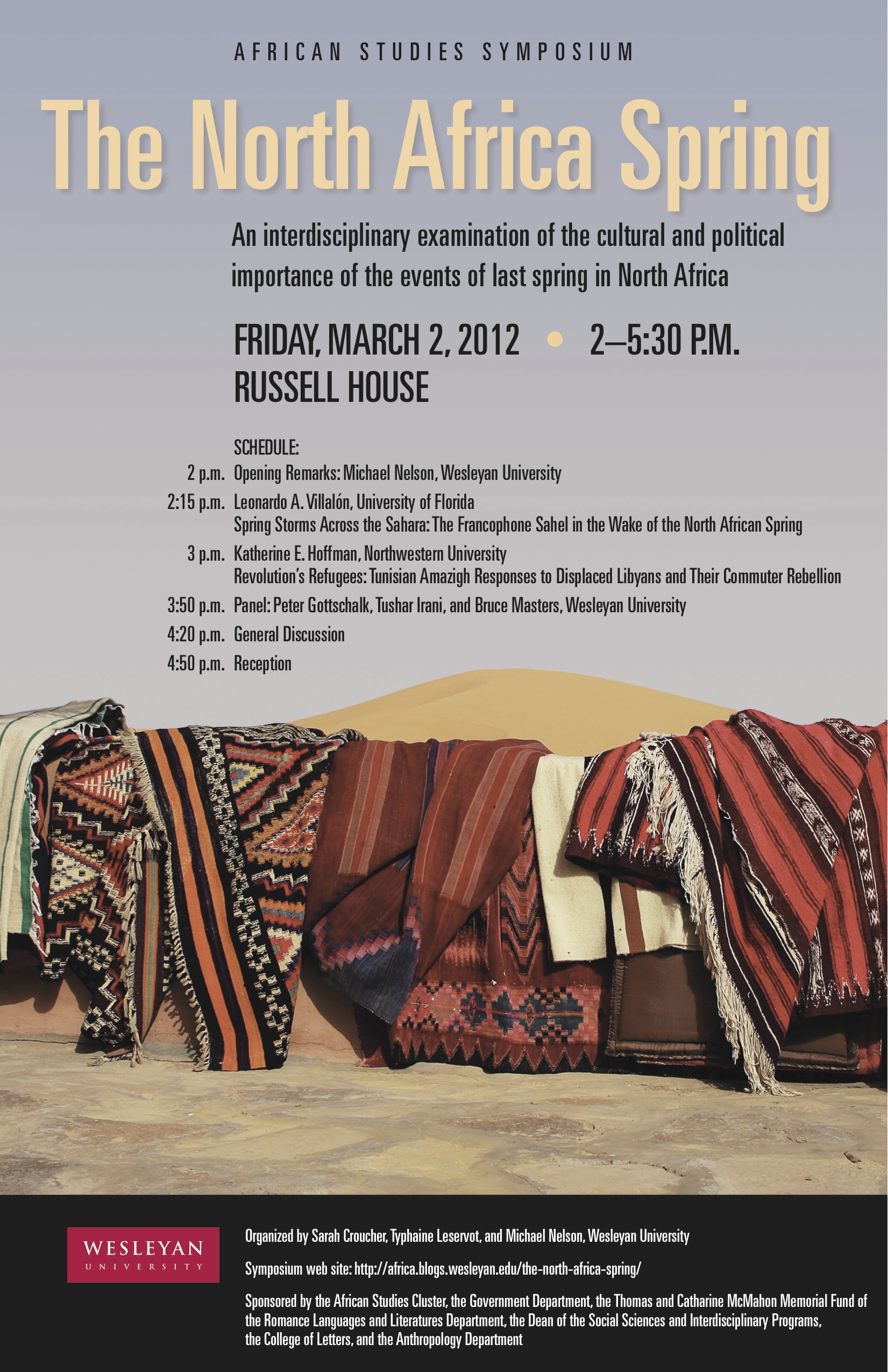
Today! The North Africa Spring

The North Africa Spring

Download PDF Here: The North Africa Spring

Our Guest Speakers:

Katherine E. Hoffman, Associate Professor of Anthropology at Northwestern University, has worked for almost twenty years among Amazigh (Berber) populations in North Africa. She is currently researching in southern Tunisia and Western Libya on the role of Amazigh ethnicity in the integration of populations displaced by political violence into the country of first asylum. The project considers as well the surprising ways in which rural Tunisian community organizing in the South during their own revolution created networks that then allowed Tunisians to host, house, and feed hundreds of thousands of refugees fleeing violence in Libya outside the auspices of international relief organizations. Hoffman is the author of We Share Walls: Language, Land, and Gender in Berber Morocco (Blackwell-Wiley 2008) and journal articles in American Ethnologist, Contemporary Studies in Society and History, Ethnomusicology, and Language and Communication. She is co-editor (with S.G. Miller) of Berbers and Others: Beyond Tribe and Nation in the Maghrib (Indiana University Press 2010). Hoffman will be a Eurias Senior Fellow at the Institute for Advanced Study in Nantes during the 2012-2013 academic year where she will be working on her book manuscript Mirror of the Soul: Custom, Islam, and Legal Transformation under the French Protectorate of Morocco (1912-1956).

Leonardo A. Villalón is associate professor of Political Science and African Studies at the University of Florida.  From 2002-2011 he served as director of the university’s Center for African Studies. He has published numerous works on religion and politics and on democratization in the Muslim countries of the African Sahel, where he has lived and traveled broadly over the past twenty years.  He has taught for three years in Senegal, at the Université Cheikh Anta Diop in Dakar and the Université Gaston Berger in St. Louis.  From 2001-2005, he served as president of the West African Research Association (WARA).

His current research focuses on religion and democracy in Senegal, Mali and Niger, as well as on social change and electoral dynamics across the Francophone Sahel. From 2007-09 he was named a Carnegie Scholar by the Carnegie Corporation of New York, for a project entitled: “Negotiating Democracy in Muslim Contexts: Political Liberalization and Religious Mobilization in the West African Sahel.”  He is completing a book based on that research. With Mahaman Tidjani Alou of LASDEL (Niger) he directs a research  project on religion and educational reform in the Sahel.  He is also co-directing the two-year State Department funded “Trans-Saharan Elections Project,” focused on six countries: Senegal, Mauritania, Mali, Burkina Faso, Niger, and Chad.

Sponsors: The African Studies Cluster, the Government Department, the Thomas and Catharine McMahon Memorial Fund of the Romance Languages and Literatures Department, the Dean of the Social Sciences and Interdisciplinary Programs, the College of Letters, and the Anthropology Department

Fighting Somali Piracy In London

David Leonard, writing for African Arguments, has an interesting take on the need to combat the international roots of the Somali piracy problem:

The real solution to Somali piracy lies with a partnership between NATO navies and European commercial interests. NATO needs to prevent international exploitation of Somali fishing waters while also patrolling defined maritime corridors. Higher insurance rates would induce international vessels to stay within these corridors. Ships should also employ self-protections, such as safe lock-in rooms for the crew, so that NATO patrol vessels can reach them before pirates force them to surrender. Finally, the focus should be on capturing those who plan and fund piracy, more than on the young-men who board the ships. Finding the organisers could start with tracking how piracy is financed and how ransoms are distributed. These solutions suggest that it is indeed in the financial hub of London, not just along the coasts of Puntland, that Somali piracy must be tackled.

Wandering and rambling

I can tell the academic year is approaching partly because the academic blogosphere seems to be getting busier. Or perhaps I am just starting to pay more attention again.

My Wesleyan colleague, Erica Chenoweth, has been making some fantastic posts in her new blog, Rational Insurgents.

Chris Blattman has an interesting piece on an experiment that was run on South African politicians. The tentative conclusion of the research by Gwyneth McClendon is that They tend to be more responsive to co-ethnics and to “unifying” issues. Over at the Monkey Cage, a few thoughts we expressed as to the ethics of the approach (Sides doesn’t seem to critical of it) as well as useful links to other similar experiments.

Deborah Brautigam continues her very helpful quest to set the record straight on the roles China may be playing in Africa. Her most recent focus has been on The Economist. See here and here.

Over at the Duck of Minerva, Josh Busby has published a nice series on the famine in East Africa. Part V is here.

A clear sign that the summer season might be ending is that the online debate between Dan Drezner and Anne-Marie Slaughter seems to finally be dying down. Henry Farrell at the Monkey Cage has a nice overview of the majority of that debate (it wasn’t–isn’t?–over yet). Farrell tries to insert his own voice in he with a mention of contagion as a useful metaphor for international politics. I think the key point to remember is that each has their own unique starting assumptions and beliefs about politics and human nature… But, oh wait, isn’t that obvious? Incommensurable worldviews make debate difficult. What could have made this all more interesting, theoretically, is if a little more was done to attempt bridging these perspectives. All of this reminded me of David Lake’s recent article, “Why “isms” Are Evil: Theory, Epistemology, and Academic Sects as Impediments to Understanding and Progress“. I find it interesting that, in many ways, his attempt to knock down the divisions between the different mainstream schools of thought in IR (such as some of those dividing Drezner and Slaughter and, ultimately to break down barriers between our major fields) simultaneously embraces diverse understandings of the truth of IR while pointing a possible way towards that holy grail of a grand unifying theory for IR. He might disagree with me that these are his purposes, but it is hard for me not to see such possibilities. That said, he, Drezner and Slaughter all seem to underestimate the epistemological rifts that are likely to persist. After all, as Larry Laudan teaches us, there are those who have no problem with the existence of impediments to progress given that progress should neither be possible nor, therefore, a goal. Not something I believe, but that perspective persists…