Africa Notes: WTO Roundup

The WTO and Sustainable Development
Lesotho Ambassador Mothae Maruping is the current chair of the WTO’s Committee on Trade and Development. ICTSD has a nice report of their recent meeting and its focus on sustainable development. One thought is how to integrate the WTO’s Aid for Trade program with the goal of developing a green economy. Nevertheless, it is clear that some developing countries may also see the WTO as a shield from any radical green agenda that might try to restrict their ability to trade. The delegate from Benin:

Benin said that the WTO should facilitate the elimination of distorting trade practices related to environment that are “incompatible with sustainable development”. “It is important to avoid creating new trade barriers, imposing new conditions to aid, and deepening the technological gap between developed countries and developing countries

The WTO and Regional Integration within Africa
Peter Draper has a nice discussion of the relevance of WTO rules for regional integration efforts in Africa (ICTSD). He anchors his discussion with consideration of the proposed tripartite preferential trade agreement (T-PTA) between SADC, COMESA, and the EAC (basically uniting southern and eastern Africa). He points to a WTO report which singles some of the issues in maintaining coherence between WTO rules and the rules of these new trade arrangements. His overall conclusion seems to be that the negotiating parties strive to maintain coherence with WTO rules and perhaps even allow the WTO’s help with a “mulilateralizing regionalism” component.

Doha Round
Trying to Move Forward
The BRICS would like to remind us that Doha is not yet dead (MN). Both at their own summit last month and at a G-20 meeting in Mexico, they made this point. The WTO’s Director-General Pascal Lamy continues to try to breathe new life into the round. His most recent innovation is the creation of a 12-person panel of stakeholders which include corporate leaders, former heads of state, and leaders of various international institutions. Former President of Botswana, Festus Mogae is the sole African representative to the panel.

Positive DevelopmentsAgriculture
One of the major sticking points has been agriculture, especially for many African countries. The Doha Round began with a major campaign criticizing European and American farm subsidies and support for undermining agriculture in developing countries. Many of these subsidies continue, but there are some signs of change in Europe, at least. ICTSD reported this week that total EU farm support has dropped a bit and overall trade-distorting support has dropped even further:

Overall trade-distorting support – a category including amber, blue, and de minimis support – reportedly fell to €18.3 billion, a figure that is below the €22 billion cap that would be established under the draft Doha agriculture accord. (ICTSD)

Is Doha Dead?

Monty Python: Not Dead Yet

Noted: BRICS roundup

The BRICS have been very active in recent weeks. The significance of an alliance of Brazil, India, and China is not lost on many. But occasionally some have wondered whether Russia deserves to be in the group and South Africa’s entry last year raised a few eyebrows (and still does).

The Summit
Their summit in New Delhi, held on March 29, included a number of activities that suggest the group is strengthening its institutional bonds. Here is a brief description of some of their outputs:

The Delhi Declaration, capturing the essence of discussion as well as putting forth common position of BRICS countries on various economic and political issues of global and regional importance was issued at the end of the Summit. The Declaration included Delhi Action Plan which highlights the activities to be undertaken under India’s chairmanship of BRICS to further cooperation. Two agreements namely- “Master Agreement on Extending Credit Facility in Local Currencies” and “BRICS Multilateral Letter of Credit Confirmation Facility Agreement”- were signed by the Development Banks from BRICS countries. The Leaders also released “The BRICS Report” focusing on synergies and complementarities between the BRICS economies and highlighting their role as growth drivers of the world economy. An updated edition of BRICS Statistical Publication was also issued at the occasion.

They make a number of bids for their relevance to any future decision-making about the global economy. There is, for instance, this statement in their declaration:

BRICS is a platform for dialogue and cooperation amongst countries that represent 43% of the world’s population, for the promotion of peace, security and development in a multi-polar, inter-dependent and increasingly complex, globalizing world. Coming, as we do, from Asia, Africa, Europe and Latin America, the transcontinental dimension of our interaction adds to its value and significance.

In a recent op-ed, Jeffrey Sachs worries about whether the multi-polar environment signaled by the rise of the BRICS means a loss of leadership at a time when the world needs a clear leader (Business Insider). Jeremiah Kure at Mail & Guardian’s Thought Leader voices a thought commonly heard in some corners of the developing world: maybe it is about time the US and the North Atlantic-led world order change.

The Global Economy
The clearest place where the BRICS are trying to have an impact involves the global economy. This year was only their fourth summit, but their action items are getting clearer. Collectively, they have a lot of potential to collaborate on financial and economic matters (Ghosh). One of their more tangible plans is the launching of a development bank in the first quarter of next year and apparently located in South Africa (Reuters). While this definitely provides a challenge for the other global IFIs, the BRICS are not yet giving up on the IMF and World Bank. They are just repeating their previous bid for greater voice in those global institutions. Most recently, they told the IMF they would provide more cash if they could expand their decision-making role (Reuters). Of course, there is some irony that it is euro-zone countries that are in need of this cash.

The BRICS also have not given up on the WTO’s Doha Round of trade negotiations.

we will explore outcomes in specific areas where progress is possible while preserving the centrality of development and within the overall framework of the single undertaking (ICTSD)

Beyond Economics and Finance
Security
The BRICS agenda is not solely economic. Their own agreement that they are not bound by the West’s decisions to sanction Iran (which they definitely are not, legally), suggests they are interested in flexing some political muscle as well. (And it is useful to note that the only BRICS country NOT to ever have had nuclear weapons is Brazil, although it did have a bit of a program for a brief period of time.)

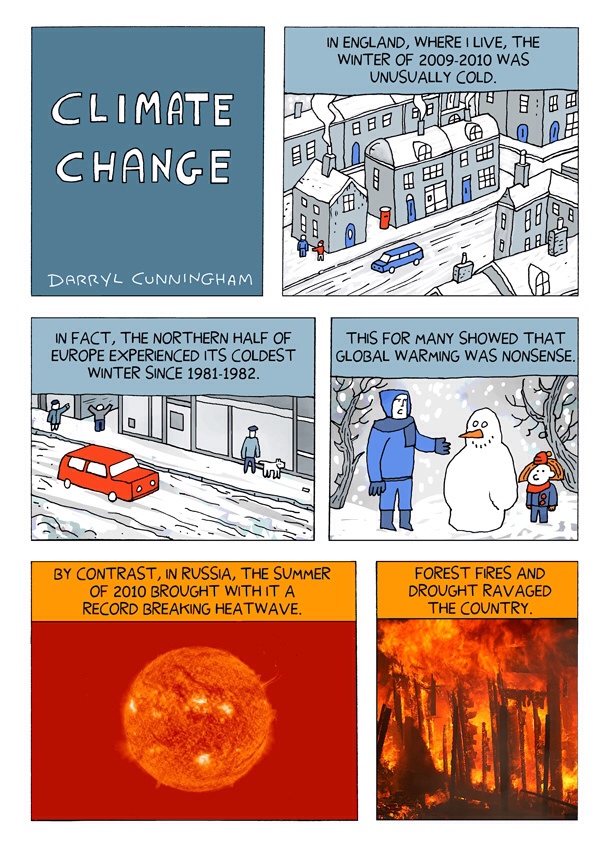
Climate Change
Unfortunately, the BRICS also seem unlikely to provide leadership on climate change. Their priorities are clearly on economic development. This is what they state in their declaration:

We affirm that the concept of a ‘green economy’, still to be defined at Rio+20, must be understood in the larger framework of sustainable development and poverty eradication and is a means to achieve these fundamental and overriding priorities, not an end in itself. National authorities must be given the flexibility and policy space to make their own choices out of a broad menu of options and define their paths towards sustainable development based on the country’s stage of development, national strategies, circumstances and priorities. We resist the introduction of trade and investment barriers in any form on the grounds of developing green economy.

Course Notes – IL & GEP: Equity and climate change governance

My students in both classes have been focusing on climate change governance this week. One of the key themes that emerges is the question of equity. Does fairness matter here? (A question I won’t directly address because it is a take-home exam question!). What are the politics of equity and how does that translate into legal texts? As one student posted on my International Law blog:

I would argue that the concept of equity and how to measure it is the underlying issue.

A great source on these issues is Parks and Roberts’ 2008 article, “Inequality and the global climate regime.” Inequality, they note, is relevant to the interests of states who vary in their production of emissions and their vulnerability to climate change, and their capabilities for action on climate change issues (decision-making power in international regimes, for instance).

What are the prospects for collaboration on climate change given such inequalities? As one of my students noted, there are mechanisms for side payments to developing countries, to make participation in these agreements more attractive:

One of the many obstacles to international environmental protection is the economic interests of poorer nations.  In working to eliminate CFCs, the international community managed to solve this problem by creating a fund to help developing nations

Another student, considering the Montreal Protocol and its side payments to developing countries, seems to wonder whether the reasons for treaty ratification should matter to us:

What would the compliance rate have been had the Protocol not provided for these incentives or provided assistance for developing countries? While some states signed the treaty out of real concern for the environment, it seems most states only did so for financial reasons and to avoid conflict.

One of my students makes an even bolder and (perhaps) more controversial claim about the rights of the current generation in developing countries:

The environment is important and I believe that the international community should take action to protect it.  However ensuring the welfare of people alive today is far more important than ensuring the welfare of the world’s future population.

The problem of inequality has been–and will continue to be for some time–THE main issue is negotiations about climate change and economic governance (where my IL class will turn their attention to next).

Course Notes – IL: The Precautionary Principle

A couple of my students have engaged in a discussion on our course blog regarding the precautionary principle.

One student noted some of the potential advantages to principle:

In the U.S. (considering the increase in political chatter about domestic oil drilling) perhaps some of the uncertainties about byproducts from drilling fluids, fracking fluids, and accident/spill oil and their health effect on local populations and food stocks could be used to mitigate some of the “Drill baby, drill!” legislation being put forth by policymakers who are in the pocket of big oil?

Another student notes a potential disadvantaget:

At what point is there enough research to predict or think that something may pose a risk or may harm the environment?

Indeed, there are broad range of usages of the concept, something Manson does a decent job sorting out in his article “Formulating the precautionary principle”.

I shared in class the findings of Wiener and Rogers, who compare the use of the principle in the US and Europe. They find that part of the reason for our differences is our different legal systems, including the degree of protections for corporations from lawsuits, access to the courts for potential litigants, and relationships between regulatory bodies and corporations. Ultimately, the precautionary principle is about risk management, and it seems reasonable to assume that different political and legal systems have evolved different means to assess and address risks. For a defense of the precautionary principle see Sandin et al. in the Journal of Risk Research. For some of the challenges see, for instance: Bristow 2003, Peterson 2007. These all probably are not the best sources but are decent places to start.

My own take is that it is easy to take the precautionary principle to an unreasonable absolutist place. There are also problems in terms of the selective application of the principle. Consider the issue of food risks. We may be quick to apply the principle to the introduction of new foods such as those which are “genetically modified”. But there are many foods that we currently consume that have both known and unknown risks. Even coffee, which I drink gallons of every week, has plenty of scientific evidence against (and for!) it.

Africa Notes: Spotlight on Angola

Inside Angola

This year may prove to be a critical year in Angola’s political development. The upcoming parliamentary elections are an important chance to move toward democratization. There will not be a presidential election as the presidency now goes to the leading candidate of the party who wins the general election, a completely unique selection mechanism (VoA). While there is an active opposition (UNITA still lives on), it is relatively weak. Dos Santos will likely remain President.

There are some positive developments in Angolan politics. While it is unlikely that it accurately conveyed the full human rights situation, Angola did– for the first time–present a report on its current human rights situation to the African Commission on People and Human Rights (Angpop). Their report is available here: Republic of Angola: Implementation of the African Charter of Human and People’s Rights. It should be noted that a number of African countries have never participated in the process and most have only issued 1-3 reports (ACHPR).

Angola and Central/Southern Africa
It is never entirely clear whether Angola fits best within our conventional understanding of “southern” or “central” Africa. Certainly, when viewed as part of the later, it is the dominant sub-regional power. Angola, however, may find its influence somewhat diminished by the recent coup in Guinea-Bissau. Angola has had a significant economic and military partnership with the ousted leadership and, as a brief statement by Executive Analysis suggests, the new regime is likely going to want to reduce at least some of Angola’s influence. That said, the coup planners have faced a number of important obstacles. It is still possible things will go Angola’s way.

Angola and Europe
Angolan-European relations continue to remain strong. Angola and the European Union are reportedly close to a new economic partnership deal (Reuters). This is being compared with the “strategic partnerships” Angola is or has negotiated with the US, China and others. Cooperation extends to political areas as well. Angola also reportedly invited the EU to send observers to monitor the election later this year (iol news).

Finally, Angola made a little bit of a splash in the news last fall when it became apparent that the former colony was now providing the investment its former colonial masters in Portugal sorely need. There apparently has been a little bit of a backlash, however, prompting Angola’s ambassador to defend those investments (Angop).

Angola and the US
Recent reporting by the Financial Times highlights a scandal in Angola-American relations. Three Angolan officials secretly had interests in a Houston-based Cobalt International Energy oil venture. The allegation is that these officials were bought off by Cobalt, making Cobalt potentially liable under US anti-corruption laws. One of these Angolan officials is Manuel Vicente, the recent head of state-owned Sonangol and widely regarded as a potential eventual successor to President Dos Santos (African Diplomacy).
        The Cobalt story probably first broke at Maka Angola, a site dedicated to anti-corruption in Angola.

Course Notes – GEP: Big Dams!

China’s Three Gorges Dam may be a huge mistake, reports Business Insider. Criticisms of the project are by no means new, but the most recent statements that 100,000 people may still need to be moved in response to landslide risks around the dam have brought its downsides back into focus.

Meanwhile, China continues to be involved in major dam projects around the world. One such project is the Grand Ethiopian Renaissance Dam, a project which is creating major conflict between Ethiopia and Egypt. The Economist recently called it the “jewel” of Ethiopia’s hydropower strategy, expected to generate 5250MW of energy when finished increasing electricity production in Ethiopia fivefold. This is more than twice Ghana’s current electricity production from hydropower. Here is Egypt’s Minister of Water, Mohamed Nasr El Din Allam, interviewed just recently:

In short, it would lead to political, economic and social instability. Millions of people would go hungry. There would be water shortages everywhere. It’s huge (The National).

While Ethiopia is funding much of the project by issuing its own bonds, approximately $1.8 billion in turbines and electrical equipment are reportedly being financed by Chinese banks (The Economist).
wpid-20110423_mam964-2012-04-24-20-25.jpg

Africa Notes: News Around the Continent

All Africa
Several African women make Foreign Policy’s list of “The Most Powerful Women You’ve Never Heard Of”: Ngozi Okonjo-Iweala, Fatou Bensouda, Fayza Abul Naga, and Lindiwe Mazibuko.

The World Bank forecasts faster growth for sub-Saharan Africa based on high commodity prices and investments in mining. Growth should be about 5.2 percent this year for the region as a whole (Reuters).

Ghana
Ghana, which has increased its borrowing of late–including recently asking for a 6 billion-dollar loan from China (Reuters)– apparently has some reason to think it can handle the debt. Vice President Mahama disclosed at the Third Ghana Policy Fair that Ghana should earn 1 billion dollars per year from gas (Samuel Obour).

Guinea-Bissau’s Coup
Coup planners are finding themselves in trouble with, well, with just about everyone. David Stephen has a nice discussion of the international community’s reactions to the coup (African Arguments).

Liberia
On Thursday, we will hear the verdict for ex-Liberian President Charles Taylor, currently on trial at The Hague (Reuters).

Kenya
Oil rights may be a new source for conflict between Kenya and Somalia (Reuters). Some cynics might even wonder whether this has been an impetus for Kenya’s recent military interventions in Somalia (which I have no evidence of!).

Mali
The crisis in Mali continues. Many of the top politicians have been arrested (Sahel Blog). “Loyalist” soldiers are apparently on their way north to try to reclaim territory from the Tuaregs (Reuters).

Mauritania
CNN has a special report on slavery in Mauritania (Global Voices).

Sudanese War
The conflict in Sudan shows no signs of letting up. Bashir reportedly has vowed not to negotiate:

We will not negotiate with the South’s government, because they don’t understand anything but the language of the gun and ammunition (Reuters)

Lesley Warner has a nice discussion of the reasons why Uganda might intervene in any Sudanese conflict (Lesley on Africa). I think the security concerns are probably the most important immediate impetus with economic concerns not far behind.

Uganda: Kony 2012
Ugandan troops are also still on the hunt for Joseph Kony, who is likely somewhere in the border regions of Central African Republic, South Sudan, or the DRC (Reuters).
Meanwhile, there are some new resources on Kony. Both include contributions from respected academics.

  • There is a new ebook, Beyond Kony 2012, which may prove to be an interesting read (I have not read it yet!).
  • And there is a new website, makingsenseofkony.org, which really looks quite comprehensive.

Africa Notes: Famous Africans, Kony 2012, and a Cocoa Map

Famous Africans
Nigerian President Goodluck Jonathan is on Time Magazine’s list of 100 Most Influential People in the World. Other Africans who made the list include: South African Paralympic medalist Oscar Pistorius, Egyptian Samira Ibrahim, Tunisian scholar-politician Rached Ghannouchi, and Gambian Fatou Bensouda, the new head of the International Criminal Court.

Kony 2012
Opinio Juris
has an interesting set online forum on “Kony 2012: The Social, the Media, and the Activism: Kony Meets World.”

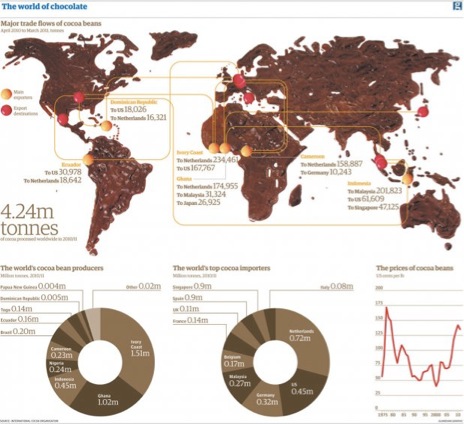
The Cocoa Map
The Guardian’s “World of Chocolate” via Business Insider. Ghana and Cote d’Ivoire are the clear global leaders in production, but I must say I hadn’t realized how important Indonesia is to this market.
wpid-chocolate-map-2012-04-19-23-11.jpg