Africa Notes: Update on the Sudanese War

Updates (4/20): Uganda now says that it is prepared to help defend South Sudan in the case of invasion, which military analysts suggest makes that fight more than even (Washington Post). South Sudan is withdrawing from Heglig, the area I mention below (Times of India).

The conflict between Sudan and South Sudan is unfortunately developing rather quickly in a rather nasty direction. In my last post I suggested that South Sudan might have a claim to some of the moral high ground in the conflict, but recent events clearly muddy that picture. UN Secretary-General Ban Ki-moon has called South Sudan’s seizure of an oilfield “illegal”:

I call on South Sudan to immediately withdraw forces from Heglig. This is an infringement on the sovereignty of Sudan and a clearly illegal act (Reuters)

Meanwhile, Bashir is firing up his rhetorical machine. He reportedly told a rally:

These people [South Sudan] don’t understand, and we will give them the final lesson by force. We will not give them an inch of our country, and whoever extends his hand on Sudan, we will cut it. (Reuters)

Over at The Economist, they captured an even more worrisome quote:

We say that it [South Sudan’s leadership] has turned into a disease, a disease for us and for the South Sudanese citizens. The main goal should be liberation from these insects and to get rid of them once and for all, God willing

As The Economist notes, one hopes that this is mostly just talk but the fighting that has already gone on suggests it could be more than that.

Course Notes – IL: Philippines v. China and the Law of the Sea

China has a long history of disputes with other nations regarding their sovereignty over islands. Japan and China are currently at odds over some islands in the East China Sea (owned by a private Japanese individual). Vietnam recently sent six Buddhist monks to lay claim to the Spratly Islands in the South China Sea. And this, coupled with the even more serious contestation between China and the Philippines, amounts to what some (including Walter Russell Mead) are calling “the Great Game”.

Map of the Spratly Islands:
wpid-China-claims-Paracel-Spratly-Islands-11-2012-04-18-13-33.jpg

The biggest contest in recent days seems to be between China and the Philippines, again near the Spratly Islands which are also desired by Vietnam (Business Insider). Philippine warships reportedly threatened Chinese fishing vessels, raided ships, and faced-off with Chinese surveillance vessels. China has deployed ships and aircraft to the region. Of course, the Philippines is a strategic ally for the United States, so it may come as no surprise that all of this is happening just as their annual joint American-Filipino military exercises began in the South China Sea (Washington Post). However, as Julian Ku notes over at Opinio Juris, it is unlikely that the Philippines will win this dispute with military force.

Could this be resolved using international law? The Philippine government seems to hope so. They have brought the case to the International Tribunal for the Law of the Sea (ITLOS). Their Department of Foreign Affairs Secretary, Albert del Rosario:

At day’s end, however, we hope to demonstrate that international law would be the great equalizer…The purpose of the exercise will be to ascertain which of us has sovereign rights over the waters surrounding Scarborough Shoal. (ABS-CBN News).

However, China may have its own sovereignty claim which, Ku notes, may make it difficult for ITLOS to have jurisdiction without China’s (unlikely) consent. And apparently China is not too keen on using ITLOS as a forum. Chinese embassy spokesperson Zhang Hua, in response to these developments, reportedly wrote:

We urge the Philippine side to fully respect China’s sovereignty, and commit to the consensus we reached on settling the incident through friendly consultation and not to complicate or aggravate this incident, so that peace and stability in that area can be restored.(Zambo Times)

So, using ITLOS is an aggravation?

Even if they cannot get ITLOS to settle the matter, they might be able to get an advisory opinion (along with Vietnam) from ITLOS on China’s claims, which could lend support for their cause, argues Ian Storey (Thanh Nien News). A case study at American University does a nice job of briefly and neatly summarizing what I believe are the key legal claims here:

The Law of the Sea Convention — an international law/standard agreed to by the countries of the world — is involved in the claims of Malaysia, Brunei, and the Philippines. These three countries claim that all or part of the islands are a part of their continental shelf. According to the Law of the Sea, the countries have legal right over the area of their continental shelf.
In 1987 China claimed that the Hainan Island–the closest recognized Chinese territory to the islands–was a separate province that would be developed as a special economic zone and declared a new law on its territorial waters in 1992. These laws gave China a greater basis for claiming control over the Spratlys as a “contiguous zones” for territory.

What is at stake here?

The islands are significant for their geographic location (shipping and military interests), fishing rights, guano, and possibly oil, natural gas and mineral resources.

Noted: Climate Change, Global Politics, and International Law

Earth Day is this Sunday and in both of my classes we are discussing the politics and international law of climate change this week and next. So I thought it might be a good opportunity to examine the recent news.

Fragmented Global Governance and Climate Change
A quick look at Reuter’s Diary on the Global Environment helps illustrate the continued fragmentary approach to these issues at the global level. Just in the next 7 days:

Regional Efforts
On a regional basis there is the Africa Carbon Forum, meeting in Addis Ababa; a “Public Forum on North America’s energy future” meeting in Canada; an “EU energy and the environment Minister’s meeting”.

Issue based efforts
Sweden’s “Stockholm+40” conference on sustainable development; The Fifth Annual Global Marine Renewable Energy Conference in Washington, DC

And if we look beyond the coming week, more of the same is happening in Asia, Europe, and elsewhere, looking at linkages between climate and water, climate and birds, the use of solar energy, and desertification. The meetings are hosted by governments, UN agencies, and regional organizations. On the one hand, we might like the fact that so much attention is being paid to these issues. On the other hand, how do we organize a response to climate change in light of such institutional complexity?

Individual state efforts to combat climate change may create problems for global talks
In Europe
While we wait on a global solution, individual countries are creating and implementing their own approaches to the issues. One example of this is a European Union law to charge airlines for their carbon emissions (Reuters). Reportedly, US airlines will comply, but China and India want nothing to do with this. Says India’s Environment Minister Jayanthi Natarajan:

For the environment ministry, for me, it is a deal-breaker because you simply cannot bring this into climate change discourse and disguise unilateral trade measures under climate change…
I strongly believe that as far as climate change discussions are concerned, this is unacceptable.

Apparently, India is suggesting that this culd be a reason for them to boycott all future climate-change talks.

In the United States
Recently, in the US there was a suggestion that the Endangered Species Act could be used to require the US to control greenhouse emissions. Since those emissions create conditions that make polar bear’s habitats less habitable, there was arguably potential scope for regulation. While this has so far been used to target domestic emissions, one can wonder whether a success in using the Act this way could also lead to pressures to regulate the actions of foreign actors whose emissions can be said to have direct effect on our polar bears’ habitats. My guess: highly improbable. But it is interesting.

Issue Linkage: Climate Change and Conservation

Finally, there is an interesting piece by Elias Ngalame at AlertNet on how Cameroon is trying to get support for climate adaptation projects in order to protect its elephants from poaching. The claim is that elephants are wandering out of the protected parks due to drought and desertification brought on by climate change, leaving them more susceptible to poaching.

Africa Notes: The Sudanese War

The news is bad. Sudan and South Sudan are, reportedly, now “locked in a logic of war” (BBC). The key disputes center on the still-disputed border regions where oil fields are present. (Map available here.)

Khartoum, unfortunately, seem to be moving along the path towards further conflict. Reports CapitalFm:

Omar al Bashir’s government says that will conscript all its citizens to fight in an all-out-war with South Sudan following an escalating oil conflict.
Sudan’s Ambassador to Kenya Kamal Ismail Saeed said on Tuesday Khartoum would sustain the war ‘at all costs’ until Juba withdraws its troops from a disputed oil field in Heglig.

AlJazeera has posted this report on how the Sudanese Parliament is now calling South Sudan the “enemy”.

South Sudan, for its part, claims that Sudan is violating the laws of war, using “indiscriminate bombing” in its attack on Heglig.

Overall, I get the sense that Sudan may be beginning to win the land war, but South Sudan may be earning broader support from its African neighbors and the international community.

Regional Dimension
There is, of course, an important regional dimension to this conflict. Two regional powers, Egypt and Kenya, have made bids to help resolve the feud diplomatically.

Thurston reports on Egypt’s roles here. As he notes, “It is not like Egypt has resolved all of its own internal uncertainties, so the fact that Egypt is making the Sudans such a high priority right now says that Egypt is quite concerned.” My view is that Egypt’s current situation also means that it is unlikely going to have the kind of impact that is needed to resolve the situation.

With the case of Kenya, objectivity may be the big obstacle to their playing a role as peace broker. Kenya has been a big winner with South Sudan’s independence. It is likely, for instance, that oil will soon flow from South Sudan to its port of Lamu (Reuters). But the recent conflict threatens both those economic interests and potentially Kenya’s broader influence in the region. As Thurston mentions at Sahel Blog, concerns about future refugees and associated humanitarian challenges are also relevant here.

Ethiopia… well, there really isn’t much news about Ethiopia’s government playing a role in any of this, though they are the host for the African Union’s efforts. Indeed, Ethiopia and Sudan seem to have their own border dispute issues (Sudan Tribune).

Efforts by the African Union, including talks held since in July in Ethiopia’s capital, Addis Ababa, have also failed thus far. As one security analyst notes: “Thabo Mbeki [former South African president who is leading the mediation] and his panel are losing their edge” (The Star).

The International Community
I am still not very clear on what roles China is currently playing in all of this. Ever since secession was clearly going to happen, China has actively courted South Sudan’s leaders. South Sudan’s President Kiir is due to make a state visit there within the next few weeks (Reuters).

As for the United Nations, no clear policy for dealing with the situation has emerged yet. Secretary General Ban Ki-Moon is making the basic pleas for peace. And the Security Council is hearing reports on the issue. One option on the table is sanctions (Reuters).

But we are all waiting.

Africa Notes: Ngozi Okonjo-Iweala: not an American, but an African, and a woman

Ngozi Okonjo-Iweala: A Missed Opportunity?
I meant to comment on this last week, before it became a moot point. But yesterday, the World Bank selected Obama’s nominee, Jim Yong Kim, as its new President (Business Insider). This should come as no surprise, as the US has always had its choice selected. And I am personally hopeful that he will do a good job.

Not an American
Nevertheless, it is still worthwhile to consider the significance of Ngozi’s candidacy. As Drezner noted, the rhetoric surrounding this reached a surprising level and for the first time the World Bank’s board did consider her in additional to the US candidate. Consider noted realist Stephen Walt’s mention of this as a “missed opportunity” for the US. He has interesting take on what the “smart” realist position should have been here:

Of course, realists expect powerful states to use international institutions to advance their own interests, which is why they want to make sure that the people in charge are reliable. If I were president, I would want the World Bank to be led by a highly competent individual who wasn’t about to harm U.S. interests. But a smart realist would also recognize that imposing the U.S. choice on others every single time is bound to trigger resentment, and encourage rising powers like China, Brazil, India, and others to redouble efforts to break Washington’s stranglehold. And every time the United States has to twist arms or use its privileged position to get its way, other states quietly seethe and anti-American forces are handed another nice talking point to use to undermine the U.S. image around the world.

But an African
Over at Global Voices, they bring the attention back to Ngozi herself, wondering whether the campaign was only symbolic.
Ngozi herself was very graceful in her concession to Dr. Kim. But she also noted that she saw this as a significant effort to reform an old institution. From her Facebook page:

by our participation we have won important victories. We have shown what is possible. Our credible and merit-based challenge to a long-standing and unfair tradition will ensure that the process of choosing a World Bank president will never be the same again. The struggle for greater equity and fairness has reached a critical point and the hands of the clock cannot be turned back.

And a Woman
So the dominant meme above is about the World Bank, the institutional reform that might be needed there, and concerns about North-South relations. We also hear online about how this was “a victory for Africa”. But it should not be missed that here we have a strong African WOMAN who played a key role in the political drama. Forbes recently listed her as the 87th most powerful women in the world. Had she secured the World Bank bid, I am certain she would have risen quite quickly in their rankings. She has a history of activism on the part of African women, s described over at the International Women’s Health Coalition. There she describes her “community” approach to supporting women’s rights:

In the early 1980s I got involved with Women in Nigeria (WIN), which was a women’s rights activist group and feminist organization with men members as well. I was one of the founding members of WIN, I started the Kano state branch, and in the mid 1980s I was the national coordinating secretary. But even at that time I felt that focusing on women alone would never bring about the kind of radical transformation of the conditions of womanhood that we envisioned for Nigeria—whether we were talking about patriarchy, or our relationships with men, or our ability to exercise our reproductive rights, or even our ability to attain reproductive health. Focusing on women or on one single issue was not going to do it—we needed to work with men and young people and women together. So, I felt that only by taking a community perspective could we create the sociocultural environment necessary for her to assert or express her full personhood as a woman.

Since those earlier days, she has risen to be a major force in Nigerian politics (the Finance Minister), and had a successful career with the World Bank, including being Managing Director prior to her current job in Nigeria. In Nigeria, her biggest battles have been against corruption. A brief recent biography at The Economist helps highlight how brave she truly is:

Death threats are no rarity, and the barrage of abuse from the national press and in online forums is continuous. Often referred to as Okonjo-“Wahala”, meaning “trouble” in pidgin, she does not tiptoe around. “If vested interests, benefiting from corruption, are attacking left, right and centre, then you are doing something right. The degree of attack is a barometer,” she says.

One of my favorite TED videos, which I often show to students, is her presentation on why Africans should accept aid. The pertinent bit begins at about 6:40, when she states:

African states have been giving the other countries aid… The UK and the US could not have been built today without Africa’s aid. It is all the resources that were taken from Africa — including human — that built these countries today.

This is a strong woman who would have been able to play an important role as head of the World Bank. But at 57 years of age, maybe this wasn’t her last chance?

See also The Guardian’s profile on Ngozi.

Africa Notes: Mali Update

Update: Just saw this link to a nice timeline of the conflict in northern Mali since 1891 on IRIN. (h/t Sahel Blog).

Things still look rather grim in Mali, though the situation is in constant flux. It might be useful to look at the situation from different vantage points:

The people of Mali
It is probably no surprise that in coups and wars much is done in the names of various peoples, but at least in the short-term, the peoples of Mali seem poised to suffer. While County and Peterson find that some in Mali may welcome the coup as an opportunity to introduce democratic reform, as Bonicelli suggests at Foreign Policy, the lessons for the impatient citizens in Mali might be the wrong one. Coups should not be normalized as a way to bring about democratic change.

Also unfortunate for the Mali people, and perhaps most immediately threatening, is a looming famine crisis.

And violence + famine = refugees here. The largest group outside of Mali is apparently in Mauritania (48,033) but at least 100,000 are internally displaced and others have fled to Burkina Faso, Niger, and elsewhere in West Africa. (IRIN)

The Azawad State
The rebels want their own state and even have a name for it (see Thurston’s comments at Sahel Blog). But what does it take to create a new state? What is required for secession to count? Lesley Warner’s take is that the Azawad rebels have “not been able to check the necessary boxes for international support” (h/t Sahel Blog). Indeed, ultimately statehood does rely on international recognition. So far, they seem quite far from getting it.

Over at Wronging Rights, they add a little more depth, citing the only document we have on what a state is, the 1933 Montevideo Convention on the Rights and Duties of States.

The Government of Mali
The coup leaders did step down. But the new interim President, Dioncounda Traore, does not seem to want to keep things calm. As has been wildly reported, he is threatening “total war” on the rebels in the north.

West Africa
West Africa has a strong tradition of tending to its own political crises, via African mediators and its own unique regional organization, ECOWAS. All of this is happening here. President Compaoré (Burkina Faso), opened talks on Saturday between Mali’s politicians and military. Notably absent: the Tuaregs.

Meanwhile, ECOWAS’ Mediation and Security Council recommended a regional force be deployed should mediation by President Compaoré fail. However, that force is not intended to deal with the coup so much as it is to deal with the rebels in the northern part of Mali. This is an important sign that the Azawad state lacks the regional allies it would need.

The International Community
The French are clear about their interests. Sarkozy:

…we must do everything to prevent the establishment of a terrorist or Islamic state in the heart of the Sahel. (Reuters)

Gregory Mann notes that in Paris, however, there are lots of views on the streets about the events in Mali (“Bamako-sur-Seine”).

Also, UNESCO is worried about the cultural treasures of Timbuktu.

And So…
And so things continue to move. I shouldn’t try to predict but… my best bet is that we will see a gradual return to constitutional rule in the southern part of the country followed by a slow and torturous attempt to regain control of the north. ECOWAS will play a key role in this and a year from now we will barely hear anything more about it. But I really hope I am wrong about the torturous bit. I would much prefer that this become an opportunity for national dialog about how to better serve the needs of the Tuareg populations in the north.

Africa Notes: Now that Timbuktu has been taken, will more of us pay attention?

The crisis continues to unfold in Mali. And maybe the coup leaders are seeing that EVERYTHING is going against them.On Saturday the pledged a quick power handover.

  • First, the coup leaders are increasingly unpopular in West Africa.
  • Uncertainty is the word Camilla Toulmin used to described the situation.
  • The view from the West
    • The UK tells its citizens to leave.
    • Walter Russell Mead continues in his Afro-pessimist vein in describing the situation. As he says, the Financial Times described Mali as “one of west Africa’s most stable countries”. So, he tells us, “This casts serious doubt on the mainstream press, NGO and foreign policy establishment line on Africa.”
  • Meanwhile, the average Malian is in for some major problems.
    • As Baz Lecocq notes, the hot season is starting in Mali and food is going to be a big issue. What is more, he suggests, the Malian army is not prepared to handle the heat of the hot season in the extreme parts of the country the rebels currently hold.
    • Oxfam has this press release on food shortages (here) (via Sahel Blog)
  • And the Mali army is losing more and more ground to the rebels. I am certain by now they must realize that former President Toure likely did not have any more resources to give them before the coup. Perhaps that was why he already was willing to step down on his own.
    • So they lost the northern town of Kidal.
    • And rebels reportedly entered and then took Gao. (and here)
    • And then on Sunday (today) they apparently surrounded Timbuktu and then planted their flag there.. Which is probably the only city most Americans have heard of. So we might finally start to see greater press attention.

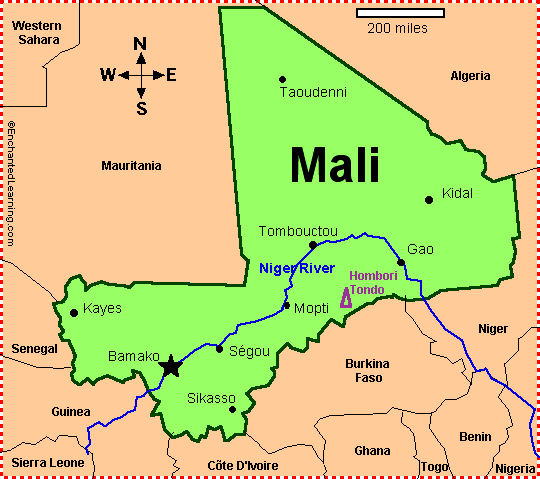
    If you examine this map of Mali (via Wars in the World), you can quickly see how rebel advances place them in control of a large swath of territory. Indeed, draw a line between Gao and Timbuktu, extend it, and you will see about half the country in rebel hands. Of course, it is the less-populated, poorer half. But it is very significant.

ISA 2012: Presentation on Participation in IOs

Here is the abstract of the paper I am presenting tomorrow:

This paper addresses an understudied, but highly relevant research question: why do states participate in some international organizations more than others?  Playing an active role in all fields of global governance requires resources that only a few countries have.  Most countries have to pick and choose where they will expend their diplomatic energies.  While others have monitored state participation in individual international organizations (for instance, on the WTO: Michalapolous 1998; Blackhurst et al. 1999), such studies have primarily focused on understanding obstacles to participation rather than considering why states may choose to participate in some organizations rather than others. A number of factors could drive those choices, including: a state’s own financial resources, a rational estimation of a countries’ primary interests, trust in coalition partners to represent their interests, external financial support for participation, and institutional inertia provided by past participation. We measure participation at two levels: meeting attendance and meeting “voice” (the number of times states actively speak during meeting, analyzed by coding meeting minutes and reports). This is part of an on-going empirical study of state participation in global governance. For the purposes of this present paper, we focus primarily on three international organizations which overlap with a focus on food safety governance: the Codex Alimentarius Commission, the World Organization for Animal Health and the World Trade Organization. We also primarily focus on patterns of African state participation.

Special thanks to my research assistant, Ivan Stoitzev!

Noted: More reactions on the Mali Coup

First, an interesting point that is often not stressed enough in the news reports on the coup: President Toure wasn’t even running in the April presidential elections. He already planned to step down. So why be impatient?

Indeed, Gregory Mann seems appropriately skeptical of the coup leaders’ lofty goals for fighting corruption and promoting democracy (Africa is a Country). Brian Peterson finds a lesson in all of this: African leaders should take grievances seriously (African Arguments). I actually was unaware of the “war widow” protests in January that he mentions.

Meanwhile, our understanding of the potential routes forward continues to develop. First, the immediate consequences of the coup are still being sorted out. The US has joined other states in suspending aid to Mali (Reuters). Meanwhile, Tuareg rebels are reportedly advancing further into Mali (The New Yorker). Thinking more about the long term, Alex Thurston usefully considers whether past West African coups have lessons for Mali (Sahel Blog). I think his fourth point, “coup leaders who cause chaos are overthrown in coups”, might be prescient.

GEP Course Notes: Oil in Africa

Drilling Africa’s Arctic | Thought Leader.

The Virunga National Park, Africa’s oldest Unesco World Heritage Site, is situated along the border of the Democratic Republic of the Congo (DRC) and Uganda.

It contains more species of mammals, reptiles and birds than any other protected area on the continent. It has an exceptional diversity of landscapes stretching from the glaciers of the Ruwenzori mountains, to indigenous rainforests, savannas, rivers, and lakes. It’s also one of the last places in Africa where mountain gorillas still survive.

Apparently a number of oil companies want to explore for oil here. Don’t know enough about this, but I knew it might interest some of you.