Africa Notes: Seeing Kony

Invisible Children is getting a lot of press for its new campaign: Kony 2012. They even have a slick movie (see below), which is something they are particularly good at.

Joseph Kony is clearly a bad guy and no one doubts this. The best piece to read on recent effort to go after Kony is a recent piece in Foreign Affairs by Schomerus et al.: “Obama takes on the LRA”. (h/t Blattman).

What I write about below is the debate about Invisible Children’s efforts and influence on US policy. But it might be worthwhile to note that another news item about the LRA seems to have been lost in the blogosphere. Reuters Africa reports that the “LRA launches new Congo attacks, may be “last gasp”.”

Is Invisible Children Doing a Good Thing Here?

There is an active debate out there about this. As one of my colleagues recently posted on facebook: “My development and academic friends think it’s the worst ever. Many other friends are urging us to watch.” That mirrors what I hear, perhaps amplified by the fact that the ex-boyfriend of a relative of a friend was one of the original filmmakers (and maybe still works with IC). A link in her comments to a Foreign Policy Blog piece by Joshuah Keating, summarizes the main critiques in its title: “Joseph Kony is not in Uganda (and other complicated things).” More generally, the criticisms focus on their tactics, on their knowledge, and on a fear of how the combination of these could lead to less-than-desirable outcomes.

Tactics
In fact, in the past a number of observers in the development and aid community have been critical of IC. For instance, over at Metblogs in 2007, they noted that people involved in an IC protest in DC lacked the most basic knowledge about Uganda and the LRA. Of course, that is actually pretty normal for campaigns of any stripe. Participants are rarely well-briefed. However, that does less to excuse their awkward “abduct yourself” campaign back in 2009. Chris Blattman, an expert on the conflict and on child soldiers in Africa, wrote:

There’s also something inherently misleading, naive, maybe even dangerous, about the idea of rescuing children or saving of Africa. It’s often not an accidental choice of words, even if it’s unwitting. It hints uncomfortably of the White Man’s Burden. Worse, sometimes it does more than hint. The savior attitude is pervasive in advocacy, and it inevitably shapes programming. Usually misconceived programming. The saving attitude pervades too many aid failures, not to mention military interventions. The list is long.

One consequence, whether it’s IC or Save Darfur, is a lot of dangerously ill-prepared young people embarking on missions to save the children of this or that war zone. At best it’s hubris and egocentric. More often, though, it leads to bad programs, misallocated resources, or ill-conceived military adventures. There’s lots of room for intelligent advocacy.

However, Blattman may be more optimistic about “intelligent advocacy” than I am. Not everyone in the US should be expected to know about Uganda and the LRA, but it could be, in this case, that a little information is better than none. (For even more information, see the recommended sources below the film clip.) Additionally, it is important to think about how we are defining the goals of the Kony 2012 campaign. If the goal is about keeping the public “aware” of the issue, then something is to be said about their tactics. My (somewhat limited) understanding is that there is a solid literature on “Why Millions Can Die and We Don’t Care” (links to Psychology Today). So while I get why it might seem like a bad idea to Mark Kersten to have “a five year-old white boy feature more prominently than any other northern Ugandan…” in the Kony 2012 film, I also get why they did it. And it definitely works at getting people’s attention.

Knowledge: The Situation is More Complicated…

On the recent Kony 2012 Campaign, Stephanie Carvin at Duck of Minerva had this to say:

To put it simply, the situation on the ground in Uganda is complex. Military humanitarian intervention has serious consequences. Ham-fistedly intervening in a conflict of which few have a nuanced understanding of the conditions on the ground, where local actors are already engaged in trying to bring about a peaceful resolution, is not going to help and may in fact serve to make a difficult situation worse. Buying a bracelet from an American run NGO will not change this.

I am increasingly getting the feeling that if this is the future of international politics and humanitarian intervention, there are high-definition troubled waters ahead.

Fear: How this can lead to worse outcomes

Mark Kersten, again:

In the end, ‘Kony 2012′ falls prey to the obfuscating, simplified and wildly erroneous narrative of a legitimate, terror-fighting, innocent partner of the West (the Government of Uganda) seeking to eliminate a band of lunatic, child-thieving, machine-gun wielding mystics (the LRA). The main beneficiary of this narrative is, once again, the Ugandan Government of Yoweri Museveni, whose legitimacy is bolstered and – if the ‘Kony 2012′ campaign is ‘successful’ – will receive more military funding and support from the US.

Final thoughts:

Invisible children have come a ways since 2007 and should be commended in their efforts to learn and communicate more effectively about Uganda. No one can argue that they haven’t tried, for instance, they have funded the LRA Crisis Tracker, something I stumbled upon via the more reputable ReliefWeb website. That said, I think Blattman and others are right that there are other experts to consult besides advocacy groups when deciding on what to do about Kony.

The Kony 2012 Movie:

Recommended sources on Uganda and the LRA:

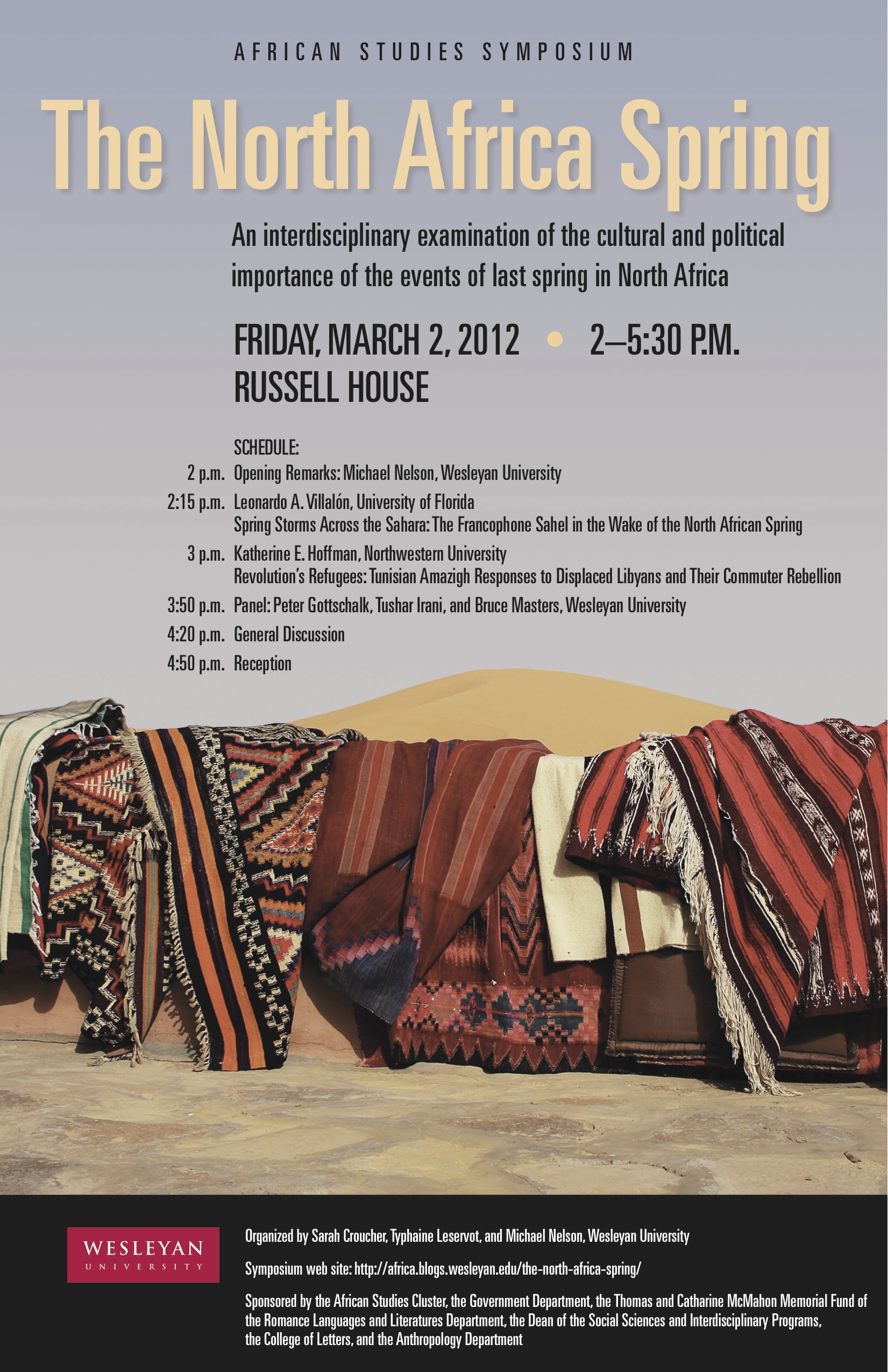
Today! The North Africa Spring

The North Africa Spring

Download PDF Here: The North Africa Spring

Our Guest Speakers:

Katherine E. Hoffman, Associate Professor of Anthropology at Northwestern University, has worked for almost twenty years among Amazigh (Berber) populations in North Africa. She is currently researching in southern Tunisia and Western Libya on the role of Amazigh ethnicity in the integration of populations displaced by political violence into the country of first asylum. The project considers as well the surprising ways in which rural Tunisian community organizing in the South during their own revolution created networks that then allowed Tunisians to host, house, and feed hundreds of thousands of refugees fleeing violence in Libya outside the auspices of international relief organizations. Hoffman is the author of We Share Walls: Language, Land, and Gender in Berber Morocco (Blackwell-Wiley 2008) and journal articles in American Ethnologist, Contemporary Studies in Society and History, Ethnomusicology, and Language and Communication. She is co-editor (with S.G. Miller) of Berbers and Others: Beyond Tribe and Nation in the Maghrib (Indiana University Press 2010). Hoffman will be a Eurias Senior Fellow at the Institute for Advanced Study in Nantes during the 2012-2013 academic year where she will be working on her book manuscript Mirror of the Soul: Custom, Islam, and Legal Transformation under the French Protectorate of Morocco (1912-1956).

Leonardo A. Villalón is associate professor of Political Science and African Studies at the University of Florida.  From 2002-2011 he served as director of the university’s Center for African Studies. He has published numerous works on religion and politics and on democratization in the Muslim countries of the African Sahel, where he has lived and traveled broadly over the past twenty years.  He has taught for three years in Senegal, at the Université Cheikh Anta Diop in Dakar and the Université Gaston Berger in St. Louis.  From 2001-2005, he served as president of the West African Research Association (WARA).

His current research focuses on religion and democracy in Senegal, Mali and Niger, as well as on social change and electoral dynamics across the Francophone Sahel. From 2007-09 he was named a Carnegie Scholar by the Carnegie Corporation of New York, for a project entitled: “Negotiating Democracy in Muslim Contexts: Political Liberalization and Religious Mobilization in the West African Sahel.”  He is completing a book based on that research. With Mahaman Tidjani Alou of LASDEL (Niger) he directs a research  project on religion and educational reform in the Sahel.  He is also co-directing the two-year State Department funded “Trans-Saharan Elections Project,” focused on six countries: Senegal, Mauritania, Mali, Burkina Faso, Niger, and Chad.

Sponsors: The African Studies Cluster, the Government Department, the Thomas and Catharine McMahon Memorial Fund of the Romance Languages and Literatures Department, the Dean of the Social Sciences and Interdisciplinary Programs, the College of Letters, and the Anthropology Department

Course Notes – IL: Universal Jurisdiction

We are also discussing universal jurisdiction this week, albeit briefly. At Erga Omnes there is an interesting post about Yemen’s amnesty law that is intended to grant President Saleh immunity for any crimes he may be complicit in. This issue underscores the tension between the objectives of peace and stability (giving a President a way out might enable an easier transition), versus justice. A separate issue is whether or not Yemen’s parliament’s grant of amnesty can have any real effect outside of Yemen.

Course Notes – IL: ATS and Corporate Persons

As I mentioned in class on Monday, the Supreme Court is hearing arguments this week on two cases Kiobel v. Royal Dutch Petroleum and Mohamad v. Palestinian Authority. These cases concern the Alien Tort Statute, an almost-forgotten law that allows foreigners who violate serious international legal rules and norms to be held accountable in the US.

Kiobel involves Shell’s complicity in the torture of Nigerian nationals. Mohamad involves complaints against the Palestinian Authority and the PLO for torture of Mohamad’s father, a naturalized American who was in the West Bank at the time.

Here are some of the big themes in the case:

1. Are corporations people?

As Peter Weiss (NY Times h/t my student, Micky Capper) notes, the Supreme Court is faced with an interesting dilemma. On the one hand, in Citizens United it granted corporations certain rights as corporate persons. On the other hand, the Second District Court has said–in essence–that corporations are not individual persons when it comes to the Alien Tort Statute. How will they reconcile these two positions? Will they?

2. The human rights angle.

Over at Erga Omnes, the human rights dimension of the case is front and center. Kiobel involves claims against Royal Dutch Shell for its role in the torture of activists in the Niger Delta (or at least helping the Nigerian government in this).

3. Comparative Foreign Law and the Risk of Political Tensions

Following the excerpts in John Bellinger’s post at Lawfare, it is clear that the issue of extraterritorial application of the ATS is of great interest to the justices. Kennedy seems concerned that the ATS is giving the US jurisdiction that no other country attempts to exercise. Alito is concerned about how this might exacerbate international tensions.

I think the petitioner’s attorney, Hoffman, makes a great – if perhaps not original – point when he states:

“I think one of the most important principles in this case is that international law, from the time of the Founders to today, uses domestic tribunals, domestic courts and domestic legislation, as the primary engines to enforce international law.”

Indeed, if international law is going to matter, it does rely on mechanisms such as the ATS.

The Obama Administration is in favor of corporate liability in these cases, reports Reuters.

For more on these cases, see:

Course Notes – IL: Medellín and Self-Executing Treaties,

Opinio Juris has had a nice discussion this week on the exact subject we discussed yesterday and will continue to discuss next week: the relationship between international law and US law. The symposium is all online:

Opinio Juris/Yale Journal of International Law Symposium: Hathaway, McElroy, and Solow on International at Home

Some highlights:

1. This begins with a discussion by Oona Hathaway, Sabria McElroy, and Sara Solow about their article: “International Law at Home: Enforcing Treaties in U.S. Courts.” Much of that discussion focusses on the Medellín case we read about. Specifically, they aim to understand how that decision impacts the enforcement of international law in U.S. courts and they offer proposals for strengthening enforcement of international law.

2. Sloss argues for a different interpretation of Medellin, and in particular the sentence in the decision that says there is a “background presumption…that [treaties] … do not create private rights or provide a private cause of action in domestic courts.” He summarizes his argument:

“In sum, it appears that very little has changed since Medellín. Before Medellín, US courts vigorously enforced transnational treaty provisions, but they were hesitant to enforce vertical treaty provisions. After Medellín, US courts are arguably more reluctant to enforce vertical treaty provisions, but their enthusiastic enforcement of transnational treaty provisions continues unabated.”

3. John Bellinger, part of the Secretary of State’s Advisory Committee on International Law, makes an interesting comment on how the Medellín decision surprised him:

“..it does not make much sense to me that the President [Bush] would order compliance with an ICJ decision knowing his order would be struck down. His order was decidedly unpopular in Texas and with conservatives, and he received little credit in the international community for his effort to comply with international law. To my knowledge, the President made his decision, based on the recommendation of his Secretary of State, because the U.S. is required under the U.N. Charter to comply with decisions of the ICJ and because demonstrating commitment to the Vienna Convention on Consular Relations (VCCR) would help protect Americans who are arrested in other countries”

4. Finally, and most recently,Vladek blogged on “Self-Execution Beyond Treaties”: Enforcement of both domestic and international obligations is becoming more problematic.

Fighting Somali Piracy In London

David Leonard, writing for African Arguments, has an interesting take on the need to combat the international roots of the Somali piracy problem:

The real solution to Somali piracy lies with a partnership between NATO navies and European commercial interests. NATO needs to prevent international exploitation of Somali fishing waters while also patrolling defined maritime corridors. Higher insurance rates would induce international vessels to stay within these corridors. Ships should also employ self-protections, such as safe lock-in rooms for the crew, so that NATO patrol vessels can reach them before pirates force them to surrender. Finally, the focus should be on capturing those who plan and fund piracy, more than on the young-men who board the ships. Finding the organisers could start with tracking how piracy is financed and how ransoms are distributed. These solutions suggest that it is indeed in the financial hub of London, not just along the coasts of Puntland, that Somali piracy must be tackled.

GEP Course Notes: Game Theoretic Approaches

Scott Barrett’s Environment and Statecraft heavily relies on game theory to make its arguments about environmental treaty-making. But what are the strengths and weaknesses of this approach?

Well, first it is important to note that Barrett has a lot of company with his approach. A nice article written in the Atlantic Monthly back in 1993, “Can Selfishness Save the Environment?”, explicitly considers how game theory was used then to discuss environmental cooperation. More recently, The Scientific American described Bruce Bueno de Mesquita’s use of Game Theory to predict the failure of the 2010 Copenhagen climate talks before they happened. And in 2011, some tried to use game theory to find ways pass the negotiating impasses at Durban: “Climate Change Solution Proposed by Scientists Incorporates Game Theory.”

In 2008, The Telegraph went so far as to say “Game theory could save the world.” That is nonsense, of course. Why? Well, while game theory does provide us with some useful tools for viewing strategic behavior (I’m not assigning Barrett without good reason!), it has a number of weaknesses as a basis for prescription, including:

  • It is only as good as its inputs, including assumptions about preferences which are rarely well understood
  • Some actors will choose to act ethically, rather than selfishly
    • However, that is not to say they are more likely to support solutions that also are in their self-interest!
  • There are a lot of limits to acting rationally… We’ll talk a bit more about this in class.
  • It is not really a theory. Rather, it is a set of analytical tools which require theoretical inputs.
  • All of which means that different analysts may come up with different predictions and prescriptions based on differences in their starting assumptions.

IL Course Notes: Actors

The theme this week, carried over from last week, is “actors in international law”. We will finish discussing states, and move on to other actors. But the unfortunate events in Syria provide a lens for thinking about some of these actors.

One of the first things we learn in international law is that sovereign states are largely treated as “equal” subjects. However, over at Opinio Juris, Jens Ohlin notes that in the area of security some actors (the permanent members of the security council) are more equal than others (the rest of the states): “Syria, Intervention, and Recognition”. This is why the Security Council cannot act on Syria. Two of its members, Russia and China, seem unlikely to allow any resolution on Syria to pass, regardless of what the rest of the world may want.

However, another interesting aspect to the Syria issue is the question of forum shifting by actors. If the Security Council’s actions can be blocked by two states, what about the International Criminal Court. Julian Ku asks this in another post at Opinio Juris:“Since the Security Council Won’t Act, Send in the ICC?” These are two somewhat independent international organizations. And while one (the Security Council) is mostly focused on regulating the behavior of states, the other (ICC) is primarily focused on regulating the behavior of individuals. Unfortunately for those who would like to see ICC action, it would likely require Security Council support, given that Syria is not a member. And, once again, China and Russia will likely block such a decision.

Sudan is a case where the Security Council did ask the ICC to investigate a state who was not a member of the ICC. However, this has proved controversial in Africa. Just last month, the African Union asked its commission to consider seeking an ICJ advisory decision on whether Sudanese President Omer Hassan al-Bashir should be considered immune, whether the ICC process is against international law in this instance. (Likely the ICC is in the right here, I would say. But it could be an interesting ICJ decision to follow, should it get there.) See: “African Union may ask ICJ for opinion on Bashir’s immunity from ICC”.

WES-FID: Some thoughts

I thought yesterday’s student-run Forum on International Development was a great success. The event was well-organized and well-attended. But most of all, I think there were opportunities for just about everyone who attended to learn something new.

Here is what I observed:

Morning Keynote
David Rice, Executive Director of NYU’s Development Research Institute, gave a nice opening keynote address, mapping out a macro-oriented perspective on development trends.

Approaches to Development
We were all invited to choose one of three presentations on “approaches to development”. I chose the Technology seminar led by Amir Hasson (Wesleyan ’98), Founder of United Villages. I thought this was a great talk about the ups and downs of being a social entrepreneur. He discussed how he began with a project developed for a graduate class at MIT to provide rural areas in India with internet access. That became an actual project implemented in Cambodia, a project which helped created UV. But today, about 10 years later, UV is doing something very different: connecting rural retailers with a more efficient supply chain. Some of the lessons: (i) you have to be ready to go when opportunities arise; (ii) you have to listen to those you want to help; (iii) technology can be an important tool for development but it comes with some caveats, including obsolescence (their technological solution for providing internet access is less useful today) and dependence on the specific development context; (iv) you need to be flexible and adaptable to take into account the above; and (v) success requires committed leadership which includes careful management at the local level.

I found it interesting that Amir did not see politics as playing a big role in their activities. Obviously, I am biased as a political scientist. But for him, the biggest issue seemed to be getting past the red-tape necessary in India for their ISP. Governance issues, in terms of their activities, were relatively unimportant. He did mention, however, that a project they did in Rwanda might have proved to be the exception to that experience. This made me wonder a bit how much the “governance” frame in development relies on a type of African exceptionalism.

Wesleyan Non-Profits
After these seminars were a series of workshops for critically assess non-profits students at Wesleyan have created. I was assigned to moderate a discussion of SHOFCO. I commented briefly about this a couple days ago. Given the expertise of our guest panelists, Harvard Professor Rema Hanna and Conner Brannen (IPA, Wesleyan ’10 and a former student of mine), we focused on the process of evaluation. I thought some of the important suggestions for SHOFCO, included:

  • Take the time to learn from the existing literature about what works;
  • Continue to build on your monitoring and evaluation program;
  • Learn from similar groups who are engaged in monitoring and evaluation (what are their best practices?); and
  • Don’t try to measure too many things with one survey.

Both Kennedy Odede and Nathan Mackenzie did a great job explaining SHOFCO’s mission and addressing some of the concerns. Both seemed to acknowledge the challenges of making the project sustainable for the long-term and the potential for mission creep. In terms of the latter, they seem to have had success thus far at finding projects that are synergistic, but there is always the concern of taking on too much before perfecting the rest. And, as Conner noted, it may be harder to measure progress in one area when one is moving in multiple directions at the same time.

In terms of involvement with the Wesleyan Community, there seemed to be a general consensus that this was a good thing that should continue into the future. As Professor Hanna noted, this is good for the students (it exposes them to parts of the world they may not otherwise visit) and for the people of Kibera (in terms of knowledge transfer). At least, I hope I am remembering her correctly! Conner and others mentioned how to them SHOFCO will always be part of the Wesleyan community. This place played a role as an incubator. Hopefully, it can assist the organization as it matures.

Lunch: Awesome food, as always, from Iguanas Ranas.

Afternoon Keynote
Nathanael Goldberg (Wesleyan ’98),
Policy Director at Innovations for Poverty Action, spoke on “How do we know what works in development?”. I thought this was the best talk of the day. Being a little familiar with IPA’s work, I suppose there wasn’t a whole lot of new information for me, but it was well-delivered and comprehensive. I especially liked how he framed what they do (randomized control trials) with the uncertain findings of past research on development projects, especially micro-finance. What I didn’t realize before yesterday was how ambitious the scope of their work is: more than 400 projects right now. There have been criticisms of their approach to development and it might have been nice to hear some of that debate flagged for our students. As they mention on their own website, there has been a little backlash. I talked recent with an economist about Randomized Control Trials and he mentioned his concern that some developing countries might be getting over-saturated with these projects. And that could become a problem. But it was inspiring to hear their mission and their success thus far. A number of our students and alumni have done work for IPA and I hope more continue to do so.

Small Lectures
There were several choices and I decided to attend Professor Rema Hanna’s lecture on “Randomized Experiments to Improve Policy”. I thought this was an especially useful talk for our students who have not been exposed to research methods. She did a great job at presenting the experimental approach that she and her development colleagues at J-PAL and IPA are using. Unfortunately…

That was the end for me…
Unfortunately, I was unable to stay until the end. And I even missed the end of Hanna Rema’s lecture. But I really came away appreciating the wonderful event our students organized. I was glad to see both of my thesis students — Rachel Levenson and Kathlyn Pattillo — playing key leadership roles alongside a host of others. I hope students consider repeating this event in the future!