Course Notes – GEP: Big Dams!

China’s Three Gorges Dam may be a huge mistake, reports Business Insider. Criticisms of the project are by no means new, but the most recent statements that 100,000 people may still need to be moved in response to landslide risks around the dam have brought its downsides back into focus.

Meanwhile, China continues to be involved in major dam projects around the world. One such project is the Grand Ethiopian Renaissance Dam, a project which is creating major conflict between Ethiopia and Egypt. The Economist recently called it the “jewel” of Ethiopia’s hydropower strategy, expected to generate 5250MW of energy when finished increasing electricity production in Ethiopia fivefold. This is more than twice Ghana’s current electricity production from hydropower. Here is Egypt’s Minister of Water, Mohamed Nasr El Din Allam, interviewed just recently:

In short, it would lead to political, economic and social instability. Millions of people would go hungry. There would be water shortages everywhere. It’s huge (The National).

While Ethiopia is funding much of the project by issuing its own bonds, approximately $1.8 billion in turbines and electrical equipment are reportedly being financed by Chinese banks (The Economist).
wpid-20110423_mam964-2012-04-24-20-25.jpg

Africa Notes: News Around the Continent

All Africa
Several African women make Foreign Policy’s list of “The Most Powerful Women You’ve Never Heard Of”: Ngozi Okonjo-Iweala, Fatou Bensouda, Fayza Abul Naga, and Lindiwe Mazibuko.

The World Bank forecasts faster growth for sub-Saharan Africa based on high commodity prices and investments in mining. Growth should be about 5.2 percent this year for the region as a whole (Reuters).

Ghana
Ghana, which has increased its borrowing of late–including recently asking for a 6 billion-dollar loan from China (Reuters)– apparently has some reason to think it can handle the debt. Vice President Mahama disclosed at the Third Ghana Policy Fair that Ghana should earn 1 billion dollars per year from gas (Samuel Obour).

Guinea-Bissau’s Coup
Coup planners are finding themselves in trouble with, well, with just about everyone. David Stephen has a nice discussion of the international community’s reactions to the coup (African Arguments).

Liberia
On Thursday, we will hear the verdict for ex-Liberian President Charles Taylor, currently on trial at The Hague (Reuters).

Kenya
Oil rights may be a new source for conflict between Kenya and Somalia (Reuters). Some cynics might even wonder whether this has been an impetus for Kenya’s recent military interventions in Somalia (which I have no evidence of!).

Mali
The crisis in Mali continues. Many of the top politicians have been arrested (Sahel Blog). “Loyalist” soldiers are apparently on their way north to try to reclaim territory from the Tuaregs (Reuters).

Mauritania
CNN has a special report on slavery in Mauritania (Global Voices).

Sudanese War
The conflict in Sudan shows no signs of letting up. Bashir reportedly has vowed not to negotiate:

We will not negotiate with the South’s government, because they don’t understand anything but the language of the gun and ammunition (Reuters)

Lesley Warner has a nice discussion of the reasons why Uganda might intervene in any Sudanese conflict (Lesley on Africa). I think the security concerns are probably the most important immediate impetus with economic concerns not far behind.

Uganda: Kony 2012
Ugandan troops are also still on the hunt for Joseph Kony, who is likely somewhere in the border regions of Central African Republic, South Sudan, or the DRC (Reuters).
Meanwhile, there are some new resources on Kony. Both include contributions from respected academics.

  • There is a new ebook, Beyond Kony 2012, which may prove to be an interesting read (I have not read it yet!).
  • And there is a new website, makingsenseofkony.org, which really looks quite comprehensive.

Course Notes – GEP: Game Theory

This is something at least some of my students will appreciate given our attention to game theory this term. Here is a PD game, with communication. Which just goes to show that communication doesn’t always make cooperation easy! Thanks to Nathan Palmer for sharing!

[youtubehttp://www.youtube.com/watch?v=S0qjK3TWZE8[/youtube]

Africa Notes: Famous Africans, Kony 2012, and a Cocoa Map

Famous Africans
Nigerian President Goodluck Jonathan is on Time Magazine’s list of 100 Most Influential People in the World. Other Africans who made the list include: South African Paralympic medalist Oscar Pistorius, Egyptian Samira Ibrahim, Tunisian scholar-politician Rached Ghannouchi, and Gambian Fatou Bensouda, the new head of the International Criminal Court.

Kony 2012
Opinio Juris
has an interesting set online forum on “Kony 2012: The Social, the Media, and the Activism: Kony Meets World.”

The Cocoa Map
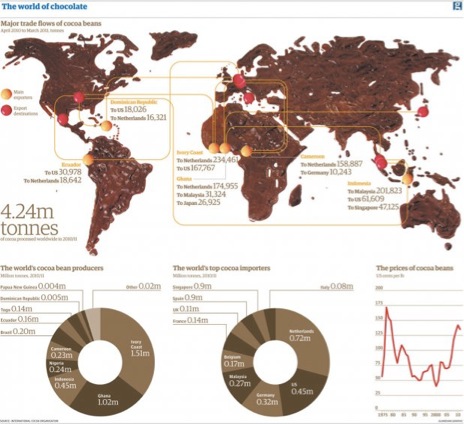
The Guardian’s “World of Chocolate” via Business Insider. Ghana and Cote d’Ivoire are the clear global leaders in production, but I must say I hadn’t realized how important Indonesia is to this market.
wpid-chocolate-map-2012-04-19-23-11.jpg

Africa Notes: Update on the Sudanese War

Updates (4/20): Uganda now says that it is prepared to help defend South Sudan in the case of invasion, which military analysts suggest makes that fight more than even (Washington Post). South Sudan is withdrawing from Heglig, the area I mention below (Times of India).

The conflict between Sudan and South Sudan is unfortunately developing rather quickly in a rather nasty direction. In my last post I suggested that South Sudan might have a claim to some of the moral high ground in the conflict, but recent events clearly muddy that picture. UN Secretary-General Ban Ki-moon has called South Sudan’s seizure of an oilfield “illegal”:

I call on South Sudan to immediately withdraw forces from Heglig. This is an infringement on the sovereignty of Sudan and a clearly illegal act (Reuters)

Meanwhile, Bashir is firing up his rhetorical machine. He reportedly told a rally:

These people [South Sudan] don’t understand, and we will give them the final lesson by force. We will not give them an inch of our country, and whoever extends his hand on Sudan, we will cut it. (Reuters)

Over at The Economist, they captured an even more worrisome quote:

We say that it [South Sudan’s leadership] has turned into a disease, a disease for us and for the South Sudanese citizens. The main goal should be liberation from these insects and to get rid of them once and for all, God willing

As The Economist notes, one hopes that this is mostly just talk but the fighting that has already gone on suggests it could be more than that.

Course Notes – IL: Philippines v. China and the Law of the Sea

China has a long history of disputes with other nations regarding their sovereignty over islands. Japan and China are currently at odds over some islands in the East China Sea (owned by a private Japanese individual). Vietnam recently sent six Buddhist monks to lay claim to the Spratly Islands in the South China Sea. And this, coupled with the even more serious contestation between China and the Philippines, amounts to what some (including Walter Russell Mead) are calling “the Great Game”.

Map of the Spratly Islands:
wpid-China-claims-Paracel-Spratly-Islands-11-2012-04-18-13-33.jpg

The biggest contest in recent days seems to be between China and the Philippines, again near the Spratly Islands which are also desired by Vietnam (Business Insider). Philippine warships reportedly threatened Chinese fishing vessels, raided ships, and faced-off with Chinese surveillance vessels. China has deployed ships and aircraft to the region. Of course, the Philippines is a strategic ally for the United States, so it may come as no surprise that all of this is happening just as their annual joint American-Filipino military exercises began in the South China Sea (Washington Post). However, as Julian Ku notes over at Opinio Juris, it is unlikely that the Philippines will win this dispute with military force.

Could this be resolved using international law? The Philippine government seems to hope so. They have brought the case to the International Tribunal for the Law of the Sea (ITLOS). Their Department of Foreign Affairs Secretary, Albert del Rosario:

At day’s end, however, we hope to demonstrate that international law would be the great equalizer…The purpose of the exercise will be to ascertain which of us has sovereign rights over the waters surrounding Scarborough Shoal. (ABS-CBN News).

However, China may have its own sovereignty claim which, Ku notes, may make it difficult for ITLOS to have jurisdiction without China’s (unlikely) consent. And apparently China is not too keen on using ITLOS as a forum. Chinese embassy spokesperson Zhang Hua, in response to these developments, reportedly wrote:

We urge the Philippine side to fully respect China’s sovereignty, and commit to the consensus we reached on settling the incident through friendly consultation and not to complicate or aggravate this incident, so that peace and stability in that area can be restored.(Zambo Times)

So, using ITLOS is an aggravation?

Even if they cannot get ITLOS to settle the matter, they might be able to get an advisory opinion (along with Vietnam) from ITLOS on China’s claims, which could lend support for their cause, argues Ian Storey (Thanh Nien News). A case study at American University does a nice job of briefly and neatly summarizing what I believe are the key legal claims here:

The Law of the Sea Convention — an international law/standard agreed to by the countries of the world — is involved in the claims of Malaysia, Brunei, and the Philippines. These three countries claim that all or part of the islands are a part of their continental shelf. According to the Law of the Sea, the countries have legal right over the area of their continental shelf.
In 1987 China claimed that the Hainan Island–the closest recognized Chinese territory to the islands–was a separate province that would be developed as a special economic zone and declared a new law on its territorial waters in 1992. These laws gave China a greater basis for claiming control over the Spratlys as a “contiguous zones” for territory.

What is at stake here?

The islands are significant for their geographic location (shipping and military interests), fishing rights, guano, and possibly oil, natural gas and mineral resources.

Noted: Climate Change, Global Politics, and International Law

Earth Day is this Sunday and in both of my classes we are discussing the politics and international law of climate change this week and next. So I thought it might be a good opportunity to examine the recent news.

Fragmented Global Governance and Climate Change
A quick look at Reuter’s Diary on the Global Environment helps illustrate the continued fragmentary approach to these issues at the global level. Just in the next 7 days:

Regional Efforts
On a regional basis there is the Africa Carbon Forum, meeting in Addis Ababa; a “Public Forum on North America’s energy future” meeting in Canada; an “EU energy and the environment Minister’s meeting”.

Issue based efforts
Sweden’s “Stockholm+40” conference on sustainable development; The Fifth Annual Global Marine Renewable Energy Conference in Washington, DC

And if we look beyond the coming week, more of the same is happening in Asia, Europe, and elsewhere, looking at linkages between climate and water, climate and birds, the use of solar energy, and desertification. The meetings are hosted by governments, UN agencies, and regional organizations. On the one hand, we might like the fact that so much attention is being paid to these issues. On the other hand, how do we organize a response to climate change in light of such institutional complexity?

Individual state efforts to combat climate change may create problems for global talks
In Europe
While we wait on a global solution, individual countries are creating and implementing their own approaches to the issues. One example of this is a European Union law to charge airlines for their carbon emissions (Reuters). Reportedly, US airlines will comply, but China and India want nothing to do with this. Says India’s Environment Minister Jayanthi Natarajan:

For the environment ministry, for me, it is a deal-breaker because you simply cannot bring this into climate change discourse and disguise unilateral trade measures under climate change…
I strongly believe that as far as climate change discussions are concerned, this is unacceptable.

Apparently, India is suggesting that this culd be a reason for them to boycott all future climate-change talks.

In the United States
Recently, in the US there was a suggestion that the Endangered Species Act could be used to require the US to control greenhouse emissions. Since those emissions create conditions that make polar bear’s habitats less habitable, there was arguably potential scope for regulation. While this has so far been used to target domestic emissions, one can wonder whether a success in using the Act this way could also lead to pressures to regulate the actions of foreign actors whose emissions can be said to have direct effect on our polar bears’ habitats. My guess: highly improbable. But it is interesting.

Issue Linkage: Climate Change and Conservation

Finally, there is an interesting piece by Elias Ngalame at AlertNet on how Cameroon is trying to get support for climate adaptation projects in order to protect its elephants from poaching. The claim is that elephants are wandering out of the protected parks due to drought and desertification brought on by climate change, leaving them more susceptible to poaching.

Africa Notes: The Sudanese War

The news is bad. Sudan and South Sudan are, reportedly, now “locked in a logic of war” (BBC). The key disputes center on the still-disputed border regions where oil fields are present. (Map available here.)

Khartoum, unfortunately, seem to be moving along the path towards further conflict. Reports CapitalFm:

Omar al Bashir’s government says that will conscript all its citizens to fight in an all-out-war with South Sudan following an escalating oil conflict.
Sudan’s Ambassador to Kenya Kamal Ismail Saeed said on Tuesday Khartoum would sustain the war ‘at all costs’ until Juba withdraws its troops from a disputed oil field in Heglig.

AlJazeera has posted this report on how the Sudanese Parliament is now calling South Sudan the “enemy”.

South Sudan, for its part, claims that Sudan is violating the laws of war, using “indiscriminate bombing” in its attack on Heglig.

Overall, I get the sense that Sudan may be beginning to win the land war, but South Sudan may be earning broader support from its African neighbors and the international community.

Regional Dimension
There is, of course, an important regional dimension to this conflict. Two regional powers, Egypt and Kenya, have made bids to help resolve the feud diplomatically.

Thurston reports on Egypt’s roles here. As he notes, “It is not like Egypt has resolved all of its own internal uncertainties, so the fact that Egypt is making the Sudans such a high priority right now says that Egypt is quite concerned.” My view is that Egypt’s current situation also means that it is unlikely going to have the kind of impact that is needed to resolve the situation.

With the case of Kenya, objectivity may be the big obstacle to their playing a role as peace broker. Kenya has been a big winner with South Sudan’s independence. It is likely, for instance, that oil will soon flow from South Sudan to its port of Lamu (Reuters). But the recent conflict threatens both those economic interests and potentially Kenya’s broader influence in the region. As Thurston mentions at Sahel Blog, concerns about future refugees and associated humanitarian challenges are also relevant here.

Ethiopia… well, there really isn’t much news about Ethiopia’s government playing a role in any of this, though they are the host for the African Union’s efforts. Indeed, Ethiopia and Sudan seem to have their own border dispute issues (Sudan Tribune).

Efforts by the African Union, including talks held since in July in Ethiopia’s capital, Addis Ababa, have also failed thus far. As one security analyst notes: “Thabo Mbeki [former South African president who is leading the mediation] and his panel are losing their edge” (The Star).

The International Community
I am still not very clear on what roles China is currently playing in all of this. Ever since secession was clearly going to happen, China has actively courted South Sudan’s leaders. South Sudan’s President Kiir is due to make a state visit there within the next few weeks (Reuters).

As for the United Nations, no clear policy for dealing with the situation has emerged yet. Secretary General Ban Ki-Moon is making the basic pleas for peace. And the Security Council is hearing reports on the issue. One option on the table is sanctions (Reuters).

But we are all waiting.