No comment yet on this one:
Ariya! An African Student Association Event
The African Students Association invites you to Ariya: The Beats of Africa. Saturday 7pm.

Africa Notes: Now that Timbuktu has been taken, will more of us pay attention?
The crisis continues to unfold in Mali. And maybe the coup leaders are seeing that EVERYTHING is going against them.On Saturday the pledged a quick power handover.
- First, the coup leaders are increasingly unpopular in West Africa.
- ECOWAS
- On Wednesday, members of the Economic Community of West African States (ECOWAS) have threatened to get involved and the organization suspended Mali from its decision-making bodies.
- On Thursday, members of ECOWAS then found their plane turned away from Bamako by coup supporters.
- Nigeria
- The Nigerian senate “is pushing for military action against Malian coup plotters” (via Sahel Blog)
- ECOWAS
- Uncertainty is the word Camilla Toulmin used to described the situation.
- The view from the West
- The UK tells its citizens to leave.
- Walter Russell Mead continues in his Afro-pessimist vein in describing the situation. As he says, the Financial Times described Mali as “one of west Africa’s most stable countries”. So, he tells us, “This casts serious doubt on the mainstream press, NGO and foreign policy establishment line on Africa.”
- Meanwhile, the average Malian is in for some major problems.
- As Baz Lecocq notes, the hot season is starting in Mali and food is going to be a big issue. What is more, he suggests, the Malian army is not prepared to handle the heat of the hot season in the extreme parts of the country the rebels currently hold.
- Oxfam has this press release on food shortages (here) (via Sahel Blog)
- And the Mali army is losing more and more ground to the rebels. I am certain by now they must realize that former President Toure likely did not have any more resources to give them before the coup. Perhaps that was why he already was willing to step down on his own.
- So they lost the northern town of Kidal.
- And rebels reportedly entered and then took Gao. (and here)
- And then on Sunday (today) they apparently surrounded Timbuktu and then planted their flag there.. Which is probably the only city most Americans have heard of. So we might finally start to see greater press attention.
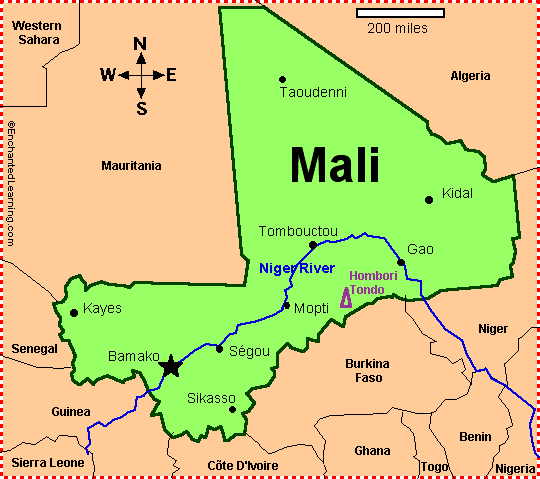
If you examine this map of Mali (via Wars in the World), you can quickly see how rebel advances place them in control of a large swath of territory. Indeed, draw a line between Gao and Timbuktu, extend it, and you will see about half the country in rebel hands. Of course, it is the less-populated, poorer half. But it is very significant.
ISA 2012: Presentation on Participation in IOs
Here is the abstract of the paper I am presenting tomorrow:
This paper addresses an understudied, but highly relevant research question: why do states participate in some international organizations more than others? Playing an active role in all fields of global governance requires resources that only a few countries have. Most countries have to pick and choose where they will expend their diplomatic energies. While others have monitored state participation in individual international organizations (for instance, on the WTO: Michalapolous 1998; Blackhurst et al. 1999), such studies have primarily focused on understanding obstacles to participation rather than considering why states may choose to participate in some organizations rather than others. A number of factors could drive those choices, including: a state’s own financial resources, a rational estimation of a countries’ primary interests, trust in coalition partners to represent their interests, external financial support for participation, and institutional inertia provided by past participation. We measure participation at two levels: meeting attendance and meeting “voice” (the number of times states actively speak during meeting, analyzed by coding meeting minutes and reports). This is part of an on-going empirical study of state participation in global governance. For the purposes of this present paper, we focus primarily on three international organizations which overlap with a focus on food safety governance: the Codex Alimentarius Commission, the World Organization for Animal Health and the World Trade Organization. We also primarily focus on patterns of African state participation.
Special thanks to my research assistant, Ivan Stoitzev!
Noted: Financial Times presents “Graphic World”
In Kenya, $415m/month or $5bn/year (15% of GDP!) flows through cell phone banking.
This is from the Financial Times cool new “Graphic World” exhibit, available online and at New York’s Grand Central Terminal. Other presentations focus on “Global Economy” and “Recession & Recovery”.
Events: Chimamanda Ngozi Adichie @ Yale
A Reading and Discussion with Chimamanda Ngozi Adichie
the acclaimed author of Purple Hibiscus, Half of a Yellow Sun, and The Thing Around Your Neck
Thursday, April 5, 2012 4:30pm
Luce Hall Auditorium, 34 Hillhouse Ave., New Haven CT
Free and open to the public
Sponsored by the Council on African Studies, African Languages & Literary Studies theme group
Questions? nathan.suhr-sytsma@yale.edu
@Wes: The Brodigan Award, Apply Now!
Graduating seniors and recent alumni: don’t forget to apply for the Brodigan Award. The due date is April 6th. You can email your applications to me.
African Studies Cluster @ Wesleyan » Christopher Brodigan Award.
Noted: Random bits
Business Insider reports that “Rich People are More Likely to Cut Off Other Drivers and Run over Pedestrians.” They link to a study out of UC Berkeley and U Toronto, published in PNAS that has this abstract:
Seven studies using experimental and naturalistic methods reveal that upper-class individuals behave more unethically than lower-class individuals. In studies 1 and 2, upper-class individuals were more likely to break the law while driving, relative to lower-class individuals. In follow-up laboratory studies, upper-class individuals were more likely to exhibit unethical decision-making tendencies (study 3), take valued goods from others (study 4), lie in a negotiation (study 5), cheat to increase their chances of winning a prize (study 6), and endorse unethical behavior at work (study 7) than were lower-class individuals. Mediator and moderator data demonstrated that upper-class individuals’ unethical tendencies are accounted for, in part, by their more favorable attitudes toward greed.
Does the fallacy of division preclude us from thinking that the average American is less ethical than.. well, than most of the rest of the world? I hope so! I would like to think that such factors make us no more or less ethical…
Tom Devriendt at Africa is a Country linked to this terrific bit of “Soweto Soul”, the Baninzi music video by The Soil.
Noted: More reactions on the Mali Coup
First, an interesting point that is often not stressed enough in the news reports on the coup: President Toure wasn’t even running in the April presidential elections. He already planned to step down. So why be impatient?
Indeed, Gregory Mann seems appropriately skeptical of the coup leaders’ lofty goals for fighting corruption and promoting democracy (Africa is a Country). Brian Peterson finds a lesson in all of this: African leaders should take grievances seriously (African Arguments). I actually was unaware of the “war widow” protests in January that he mentions.
Meanwhile, our understanding of the potential routes forward continues to develop. First, the immediate consequences of the coup are still being sorted out. The US has joined other states in suspending aid to Mali (Reuters). Meanwhile, Tuareg rebels are reportedly advancing further into Mali (The New Yorker). Thinking more about the long term, Alex Thurston usefully considers whether past West African coups have lessons for Mali (Sahel Blog). I think his fourth point, “coup leaders who cause chaos are overthrown in coups”, might be prescient.
Africa Notes: Senegal has a new President
Former PM Mack Sall apparently has won the run-off election. The fact that Wade has conceded is fantastic news for West African democracy. It doesn’t quite balance out the recent Mali coup, but it is great news, nonetheless.
BBC News – Senegal’s Wade admits presidential election loss.
 Michael Nelson