55 Years Old Today
President Mill Speaks:
This week we are discussing the Montreal Protocol. And why are we discussing it? For the same reason so many others do: we want to know whether there are any lessons from that “success” that can help us resolve the problem of international cooperation on climate change.
So here are some recent posts from around the web on climate change.
Kilapanga do órfão – Café Negro (h/t Africa is a Country)
Film about “Death Metal Angola” (h/t Africa Unchained)
This looks very interesting and has great reviews already!
H/T to Deborah Brautigam
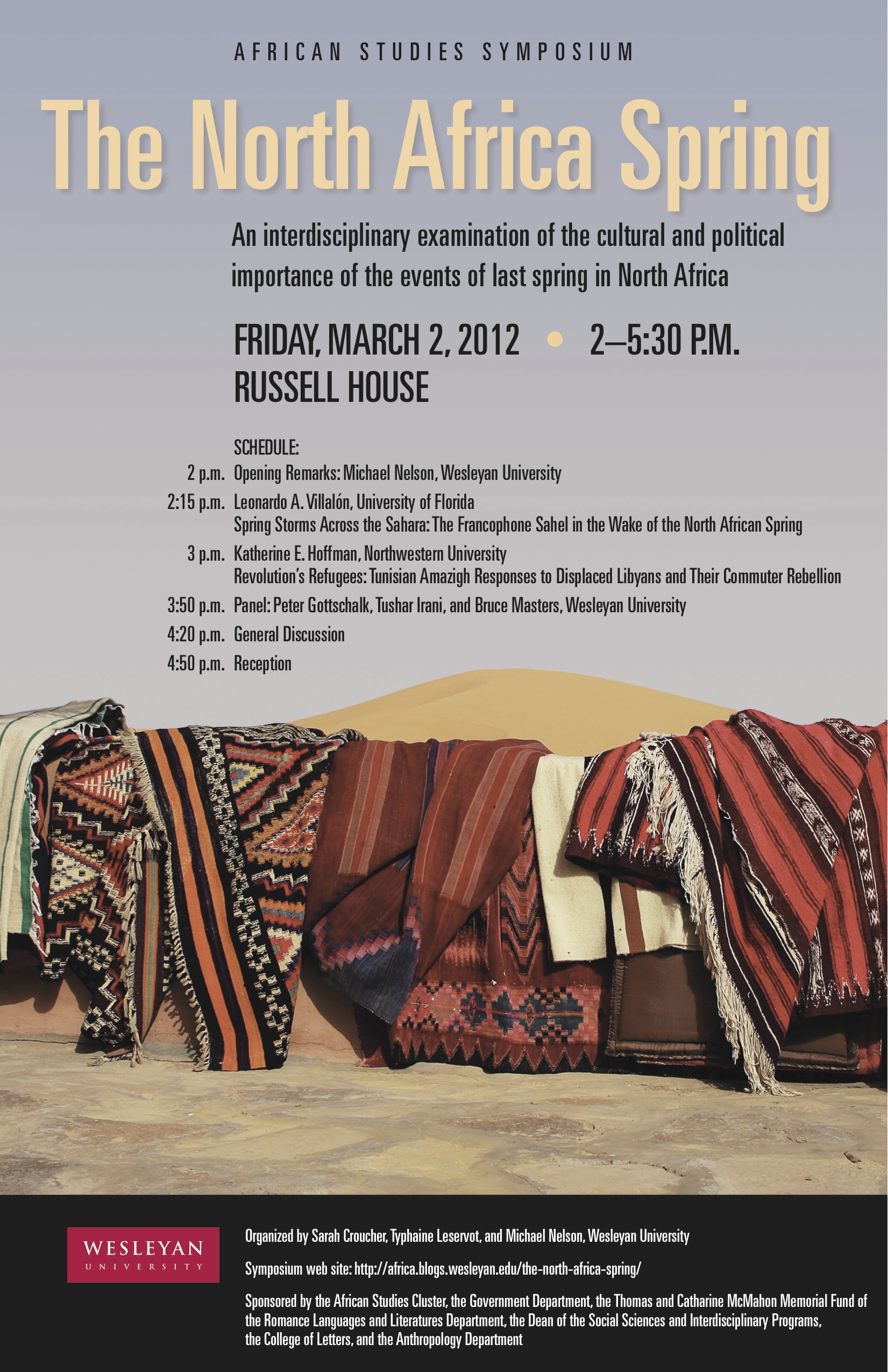
Download PDF Here: The North Africa Spring
Katherine E. Hoffman, Associate Professor of Anthropology at Northwestern University, has worked for almost twenty years among Amazigh (Berber) populations in North Africa. She is currently researching in southern Tunisia and Western Libya on the role of Amazigh ethnicity in the integration of populations displaced by political violence into the country of first asylum. The project considers as well the surprising ways in which rural Tunisian community organizing in the South during their own revolution created networks that then allowed Tunisians to host, house, and feed hundreds of thousands of refugees fleeing violence in Libya outside the auspices of international relief organizations. Hoffman is the author of We Share Walls: Language, Land, and Gender in Berber Morocco (Blackwell-Wiley 2008) and journal articles in American Ethnologist, Contemporary Studies in Society and History, Ethnomusicology, and Language and Communication. She is co-editor (with S.G. Miller) of Berbers and Others: Beyond Tribe and Nation in the Maghrib (Indiana University Press 2010). Hoffman will be a Eurias Senior Fellow at the Institute for Advanced Study in Nantes during the 2012-2013 academic year where she will be working on her book manuscript Mirror of the Soul: Custom, Islam, and Legal Transformation under the French Protectorate of Morocco (1912-1956).
Leonardo A. Villalón is associate professor of Political Science and African Studies at the University of Florida. From 2002-2011 he served as director of the university’s Center for African Studies. He has published numerous works on religion and politics and on democratization in the Muslim countries of the African Sahel, where he has lived and traveled broadly over the past twenty years. He has taught for three years in Senegal, at the Université Cheikh Anta Diop in Dakar and the Université Gaston Berger in St. Louis. From 2001-2005, he served as president of the West African Research Association (WARA).
His current research focuses on religion and democracy in Senegal, Mali and Niger, as well as on social change and electoral dynamics across the Francophone Sahel. From 2007-09 he was named a Carnegie Scholar by the Carnegie Corporation of New York, for a project entitled: “Negotiating Democracy in Muslim Contexts: Political Liberalization and Religious Mobilization in the West African Sahel.” He is completing a book based on that research. With Mahaman Tidjani Alou of LASDEL (Niger) he directs a research project on religion and educational reform in the Sahel. He is also co-directing the two-year State Department funded “Trans-Saharan Elections Project,” focused on six countries: Senegal, Mauritania, Mali, Burkina Faso, Niger, and Chad.
Sponsors: The African Studies Cluster, the Government Department, the Thomas and Catharine McMahon Memorial Fund of the Romance Languages and Literatures Department, the Dean of the Social Sciences and Interdisciplinary Programs, the College of Letters, and the Anthropology Department
Who Killed Hammarskjöld?: The UN, the Cold War and White Supremacy in Africa.

I am very intrigued by this “mystery history”, due to be released this month. Now I wonder if the Cafebreria El Pendulo that I just blogged about will carry it…
The 20 Most Beautiful Bookstores in the World « Disseminus.
I’ve been to Shakespeare & Co. in Paris, but not to the rest. Based on the pictures, I think my favorite is the Cafebreria El Pendulo in Mexico City. Anytime I can combine passions (coffee and reading) it can’t be a bad thing.

We are also discussing universal jurisdiction this week, albeit briefly. At Erga Omnes there is an interesting post about Yemen’s amnesty law that is intended to grant President Saleh immunity for any crimes he may be complicit in. This issue underscores the tension between the objectives of peace and stability (giving a President a way out might enable an easier transition), versus justice. A separate issue is whether or not Yemen’s parliament’s grant of amnesty can have any real effect outside of Yemen.
As I mentioned in class on Monday, the Supreme Court is hearing arguments this week on two cases Kiobel v. Royal Dutch Petroleum and Mohamad v. Palestinian Authority. These cases concern the Alien Tort Statute, an almost-forgotten law that allows foreigners who violate serious international legal rules and norms to be held accountable in the US.
Kiobel involves Shell’s complicity in the torture of Nigerian nationals. Mohamad involves complaints against the Palestinian Authority and the PLO for torture of Mohamad’s father, a naturalized American who was in the West Bank at the time.
Here are some of the big themes in the case:
1. Are corporations people?
As Peter Weiss (NY Times h/t my student, Micky Capper) notes, the Supreme Court is faced with an interesting dilemma. On the one hand, in Citizens United it granted corporations certain rights as corporate persons. On the other hand, the Second District Court has said–in essence–that corporations are not individual persons when it comes to the Alien Tort Statute. How will they reconcile these two positions? Will they?
2. The human rights angle.
Over at Erga Omnes, the human rights dimension of the case is front and center. Kiobel involves claims against Royal Dutch Shell for its role in the torture of activists in the Niger Delta (or at least helping the Nigerian government in this).
3. Comparative Foreign Law and the Risk of Political Tensions
Following the excerpts in John Bellinger’s post at Lawfare, it is clear that the issue of extraterritorial application of the ATS is of great interest to the justices. Kennedy seems concerned that the ATS is giving the US jurisdiction that no other country attempts to exercise. Alito is concerned about how this might exacerbate international tensions.
I think the petitioner’s attorney, Hoffman, makes a great – if perhaps not original – point when he states:
“I think one of the most important principles in this case is that international law, from the time of the Founders to today, uses domestic tribunals, domestic courts and domestic legislation, as the primary engines to enforce international law.”
Indeed, if international law is going to matter, it does rely on mechanisms such as the ATS.
The Obama Administration is in favor of corporate liability in these cases, reports Reuters.
For more on these cases, see:
Sunday’s Political Pressures in West Africa
New feeds I’ve started monitoring recently (only the first one of these is really “new”)
Africa and Development
International Relations
International Law
 Michael Nelson