Post from our own Quinta Jurecic (Wesleyan ’15)
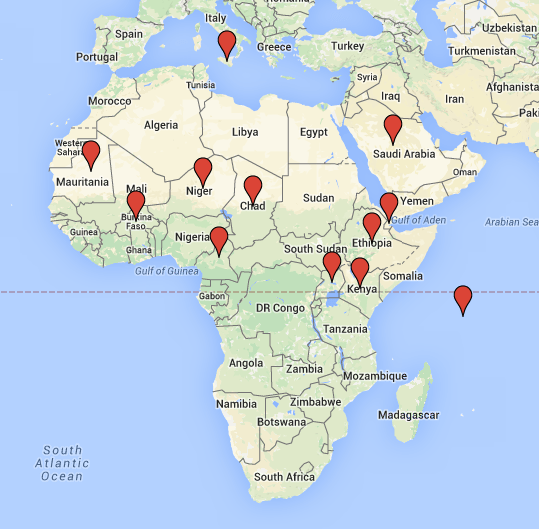
A primer on the U.S. basis for its drone bases in Africa and the surrounding areas.
Post from our own Quinta Jurecic (Wesleyan ’15)
A primer on the U.S. basis for its drone bases in Africa and the surrounding areas.
We look at Kenya’s ambitious plans to transform into a newly industrialising, middle-income country.
Source: Kenya: The new factory of the world? – Al Jazeera English
Classes are about to start!
This semester, you can find out more about my courses via the following websites (which are in the process of being updated this week).
International Law: http://internationallaw.site.wesleyan.edu/
Africa in World Politics: http://africanworldpolitics.site.wesleyan.edu/
My office hours are tentatively scheduled for Tuesdays, 11 am – 12 noon, and by appointment. I will add more hours as the rest of the semester’s schedule gets nailed down.
– Prof N.
Isaac Martin will be at Wesleyan on March 24th to talk about his recent book Rich People’s Movements: Grassroots Campaigns to Untax the One Percent.
This should be a very interesting talk. I hope you can attend. Please feel free to invite your students. We will have coffee and cookies.
Tuesday, March 24, 2015 at 4:30 p.m.
Public Affairs Center, Room 422
Sponsored by Sociology, Division II, and Allbritton.
Isaac William Martin is professor of sociology at the University of California – San Diego. He is the author of Foreclosed America (Stanford University Press, 2015) with Christopher Niedt; Rich People’s Movements: Grassroots Campaigns to Untax the One Percent (Oxford University Press, 2013); and The Permanent Tax Revolt: How the Property Tax Transformed American Politics (Stanford University Press, 2008). He is editor of The New Fiscal Sociology: Comparative and Historical Studies of Taxation (Cambridge University Press, 2009), with Ajay K. Mehrotra and Monica Prasad, and After the Tax Revolt: California’s Proposition 13 at 30 (Berkeley Public Policy Press, 2009) with Jack Citrin. He is the recipient of a Charles Tilly Book Award (2014), a Distinguished Scholarship Award from the Pacific Sociological Association (2014), a Douglas R. Maines Narrative Research Award (2012), and a President’s Book Award from the Social Science History Association.
Adrienne Lebas, American University
The Origins of Voluntary Compliance: Attitudes toward Taxation in Urban Nigeria.”
12 Noon, PAC 004
Abstract: How do states convince citizens to pay tax? Rather than focusing on enforcement, most accounts emphasize voluntary or “quasi-voluntary” compliance as an essential element in successful tax regimes. There remains, however, limited understanding of how voluntary tax compliance and the societal norms supporting it emerge.
This is an important issue in sub-Saharan Africa, where low reliance on taxation is presumed to contribute to corruption and a lack of government accountability. This paper uses novel public opinion data from urban Nigeria to examine why individuals adopt pro-compliance norms. We find that citizens respond to state delivery of services, but tax attitudes are also shaped by their access to services or “club goods” provided by non-state actors.
Adrienne LeBas (PhD, Columbia University) joined the Department of Government in the fall of 2009. Prior to joining AU, LeBas was a Prize Research Fellow at Nuffield College, University of Oxford, and Assistant Professor of Political Science and African Studies at Michigan State University. Her research interests include social movements, democratization, and political violence. She is the author of From Protest to Parties: Party-Building and Democratization in Africa (Oxford University Press, 2011), which was named Best Book by the African Politics Conference Group. Her research on party organization and violence has appeared in Comparative Politics, Studies in Comparative International Development, and elsewhere. LeBas also worked as a consultant for Human Rights Watch in Zimbabwe, where she lived from 2002 to 2003. Her most recent work looks at attitudes toward taxation in urban Nigeria.
Has Ebola broken all the rules? What do we know about past outbreaks?What is the potential political impact for Africa?
Professors Bill Johnston (History), Laura Ann Twagira (History), and Mike Nelson (Government) will discuss the recent health crisis.
Evaluating students’ evaluations of professors.
We find that teacher quality matters substantially and that our measure of effectiveness is negatively correlated with the students’ evaluations of professors.
Something for us teachers to think about. There are a number of studies that suggest the relationship between evaluations and effectiveness is at least ambiguous.
Please join us for the College of the Environment’s Annual Where On Earth Are We Going? Symposium
September 27
Click on link above for more info.
These are links my International Law students might want to look at!
 Michael Nelson