News: Looking for links between Islamic insurgents everywhere

BBC NEWS | Africa | Nigerian ‘trained in Afghanistan’.

clipped from news.bbc.co.uk

Nigerian ‘trained in Afghanistan’


Boko Haram sect member Abdulrasheed Abubakar, 23, who says he was trained in Afghanistan
Abdulrasheed Abubakar was paraded by police to make his statement


A member of the Nigerian Islamist sect behind a deadly uprising in July has confessed to receiving military training in Afghanistan, police say.

The member of the sect known locally as Boko Haram and Taliban said he had been paid $5,000 (£3,000) to do the training and promised $30,000 on his return.

The uprising in northern Nigeria left some 700 people dead, mostly militants.

If confirmed it would be the first proven link between Islamists in the oil-rich country and Afghanistan.

  blog it

News and comment: Nigerian rumored to have been killed in China

The Wall Street Journal (clip below), CNN and a number of other sources are reporting that at least 100 Africans were involved in protests over immigration enforcement in China.  The spark was apparently the death of a Nigerian who was killed during an immigration raid.

China’s increasing ties with Africa is a subject that I am turning to in my current research.  But while my own research–and that of many others–tends to focus on China’s impact on Africa, we may neglect the potential for Africans to impact China.  This is a small reminder that there is a story to be told.  According to The Guardian, an estimated 20,000 Africans live in Guangzhou (the site of the unrest).

clipped from blogs.wsj.com

China has seen its fair share of anti-foreigner protests, from the Boxer Rebellion to the May Fourth movement, and, in more recent decades, more generically termed demonstrations against Americans, Africans, Japanese and the French.

Yet for all the expat grumbling about living in China, public protests by foreign residents are virtually unknown, perhaps tempered by the awareness that we are here by choice, live in relative comfort, and would likely achieve little more than a swift deportation.

But, reflecting the very different world in which some migrants live, Wednesday saw a rare protest by over 100 African residents of the southern city of Guangzhou.

According to Xinhua, at least one person died during a brawl that erupted after police raided a Guangzhou clothing market to check passports and visas.

blog it

Reminder of my Watsan days

An old Peace Corps friend posted this link on Facebook.  It reminded me of the work I did as a Peace Corps Volunteer in Ghana.  In many parts of rural Africa it is still normal to have no access to a toilet or latrine, and it is still normal to get water from unsafe sources.  It would be great to see more attention placed on this issue, but it tends to get ignored (as are children in much of Africa).

clipped from news.bbc.co.uk

Children sanitation alert issued

By Matt McGrath BBC science reporter

Burmese children in the slum area of Rangoon


In 2004, diarrhoea killed 1.8m people, WaterAid says

Millions of children’s lives are being put at risk each year because aid agencies and governments make wrong choices about health care priorities.

This is the conclusion of a new report from the charity WaterAid.

It says that diarrhoea caused by poor sanitation is killing many more children than HIV/Aids, tuberculosis and malaria combined.

The report says the global spending on HIV/Aids hugely outweighs the amounts spent on providing better sanitation.

blog it

Some good news from Darfur

clipped from news.bbc.co.uk

On Thursday, the minister for humanitarian assistance, Haroun Lual Ruun, said Khartoum would allow those UN agencies and non-governmental organisations (NGOs) remaining in Darfur to “expand their existing operations”.

I think what we’re hearing… is that new NGOs with new names, new logos, if necessary, can come in
John Holmes UN humanitarian chief

“We have also agreed to further improve the NGOs operating environment by easing travel and visas restrictions, by reviewing the need for individual technical agreements for NGOs,” he said.

He was speaking during a visit to Sudan by UN humanitarian chief John Holmes and US envoy to Sudan Scott Gration.

Mr Holmes said that if trust was restored between the humanitarian community and Sudanese authorities, capacity lost after the expulsions could be recovered.

“I think what we’re hearing… is that new NGOs with new names, new logos, if necessary, can come in,” he was quoted as saying by Reuters news agency.

Displaced Sudanese women in Darfur, March 2009

blog it

Zuma has officially done it

So, Zuma has officially done it.  He is President of South Africa. It will be interesting to see what impact he has.  Will those who threatened to leave South Africa really leave?  Will he be successful with his populist agenda?

I was able to meet him at a lunch at UC Berkeley a little over a year ago where he — appropriately for his audience — made the argument that education would be a top priority.  Will it?

I also wonder about his impact on South Africa’s foreign policy. Mbeki had a clear agenda and goals with respect to the African region.  Will Zuma embrace the African Renaissance?  Will he improve on NEPAD, or let it falter?  Will he continue the agenda of engagement with other major developing countries, most notably India and Brazil?  I will definitely be watching!

clipped from news.bbc.co.uk

Zuma elected South African leader

Jacob Zuma


Jacob Zuma will be inaugurated on Saturday

The leader of South Africa’s African National Congress, Jacob Zuma, has been officially elected the country’s president by members of parliament.

He will be inaugurated on Saturday. The ANC won the general election in South Africa two weeks ago.

Mr Zuma’s government is expected to focus on the faltering economy, fighting crime, poverty and HIV/Aids.

He faced corruption charges, dropped on a technicality just before the polls. He always denied any wrongdoing.

blog it

From The Monkey Cage: Google’s New Data Search Tool

Google’s New Data Search Tool

With every passing month, access to social science data becomes easier.

Check out the launch of Google’s new data search tool here.

The Monkey Cage: Google’s New Data Search Tool.

See Here:

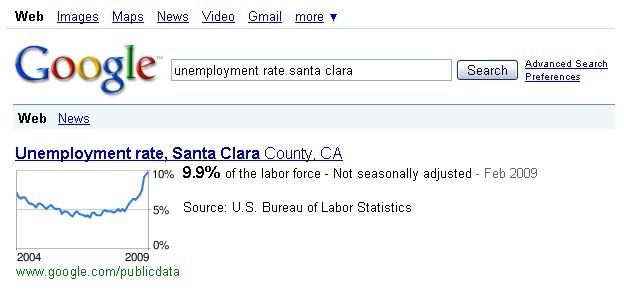
We just launched a new search feature that makes it easy to find and compare public data. So for example, when comparing Santa Clara county data to the national unemployment rate, it becomes clear not only that Santa Clara’s peak during 2002-2003 was really dramatic, but also that the recent increase is a bit more drastic than the national rate:


If you go to Google.com and type in [unemployment rate] or [population] followed by a U.S. state or county, you will see the most recent estimates:


Once you click the link, you’ll go to an interactive chart that lets you add and remove data for different geographical areas.

  blog it

News and Comment: Paris, China, Kabila, Zuma, and ECOWAS.

The BBC reports that the liberation of Paris in 1944 was carefully orchestrated to be “whites only”.  Apparently, this was an American idea. So when De Gaulle wanted to have a French division lead the liberation, he had to remove the West African soldiers (which reportedly formed 65% of Free French Forces) from the division and even had to rely on some Spanish soldiers to have adequate numbers.

China is reducing its investments in Africa, the New York Times reported last week.  But this news should not be exaggerated.  Deals are still being made and it is unlikely that China will withdraw that much from Africa. Among other activities during the last couple of weeks, Chinese telecommunications firm ZTE increased its ties with Ghana, Nigeria and China signed a pact for cooperation with satellites, brought a trade delegation to Cote d’Ivoire, and promised to build a malaria research center in Cameroon. So, while it is true that China–like just about everywhere else in the world–may be reducing its demand for certain African commodities, it is not at all the case that China will withdraw.

The New York Times also published an interesting portrait of DRC President Joseph Kabila. There was a time when people hoped that his Western-educated background would allow for new and enlightened rule of the DRC. Unfortunately, the DRC remains as troubled as ever.

South African prosecutors have apparently dropped charges against Jacob Zuma.  This should strengthen his hand considerably in the upcoming election. It may also help him if other parties are being intimidated from participating, as the BBC reports.

One random piece of news: Apparently there was a bomb threat at the Italian embassy in Ghana. I would be interested to know more about this if anyone has a clear idea.

And finally, ECOWAS proves it is still alive and attempts to insert its voice in the on-going crisis in Guinea Bissau (BBC: Guinea-Bissau army ‘beats ex-PM’; Reuters: UN urges international help for Guinea-Bissau polls) . ECOWAS has issued a statement expressing its concern about human rights violations there.

News and Comment: the G20 and Africa Part 2

The G20 has a lot of issues on its plate and at the top of the list, obviously, is the on-going financial crisis.  I have already commented on the problems African countries face in getting their voices heard. On that point, Africa may have an ally in Pope Benedict who, recently returned from his Africa travels, noted the problems of adequate representation from those “who suffer most from the harmful effects of a crisis for which they do not bear responsibility”. The Pope suggests states rely on the UN and associated institutions. Jeffrey Sachs has also jumped on this bandwagon, noting that while South Africa will be present “South Africa by itself represents South Africa”.  And we all know that South Africa is not a “typical” African country (if there is such a thing).

On the point of South Africa, it might be useful to remember that President Motlanthe himself may not be in the strongest position to represent his country’s interests, given all the recent upheaval within the South African political system and the temporary nature of his position as President.

NGOs, such as Oxfam, are trying to use their influence to encourage the G20 to commit to aiding Africa as it deals with the crisis. Duncan Green, head of research for Oxfam, highlights their main requests of the G20 in a recent blog post. He comments as well on a leaked copy of a G20 communique, obtained by the Financial Times.  Indeed, the way these conferences usually go, it is likely that at least some of the major decisions have already been negotiated ahead of time. Which leaves one to wonder whether adding an African voice at this point could make a difference.

The World Bank has published figures (reported on BBC News) that somewhat echo the gloomy global economic forecasts of the IMF and OECD.

The forecast predicts that developing countries will need $1.3tn in external financing to repay debt and cover balance of payments problems, and may fall short.

The idea that African countries, in particular, could be major losers in this crisis has been underscored by a number of analysts and commentators including Egypt’s finance minister, Oxfam’s Duncan Green (commenting on the case of Zambia), and Kofi Anan (who argues that the crisis “hits Africa twice”).

Other G20 news:

Apparently, protestors see the G20 meeting as an opportunity to demonstrate their unhappiness with a wide range of global issues, from the financial crisis to the “siege of Gaza” to the wars in Afghanistan and Iraq.  While I understand their frustrations with global leadership on these matters, I don’t think it helps their cause to get into fights with the British police.  Apparently, these frustrations are being vented worldwide.

China is trying to exhibit its leadership potential as well.  This has included lobbying for a new “super-sovereign reserve currency to replace the U.S. dollar”, the provision of advice to rich countries, and lobbying to stop states from moving towards trade and investment protectionism.

The Chinese are not the only ones worried about protectionism. Pascal Lamy, head of the WTO, has warned that moves towards protectionism may further impact the already troubled Doha round of trade negotiations.

News and Comment: last weekend of March roundup

Spanish Court Weighs Inquiry on Torture for 6 Bush-Era Officials from the NY Times.  Judge Baltasar Garzon is at it again. He was the Spanish judge who ordered the arrrest of former Chilean dictator Pinochet. He also has looked into the activities of Basque separatists and the executions of the Franco era.  This time, due to the fact that some Spanish citizens or residents were detained at Gauntanamo, Spain can claim some jurisdiction.  It will be interesting to see how far this goes.

Staying in Touch Internationally, on the Cheap from the NY Times. Includes some great ideas for using cell phones while traveling internationally.  One option it mentions is Google Voice, which has taken over from Grand Central (a service I signed up for early on but never followed through on).  This could really make things easy for those of us who travel abroad.

The African Export-Import Bank talks up the potential benefits of South-South trade. But Botswana’s Minister of Finance and Development Planning complains about how Africa is “marginalised and patronised” during the current financial crisis.

Finally, Zimbabwe retains its pariah status as the US continues sanctions. It may not help that Mugabe remains n power and continues to act friendly towards exiled former Ethiopian dictator Mengistu.


News and Comment: The G20 and Africa

In my Africa in World Politics class this week, I’ve been talking about the role of African states in global economic governance. This has been a focus of my own research, stressing the important roles coalitions can play, but how those roles are strongly influenced by the institutional and strategic environments that states operate in.  At the World Bank or IMF, African coalitions tend to have no impact due at least partly to the power and voting structure of those institutions. At the WTO, coalitions have had major impacts in negotiations (the Cairns Group in the Uruguay Round, the “Cotton Four” group of African countries more recently).

Right now many of the important issues regarding our global economy are being debated by a forum of industrialized and emerging market countries, the G20. Their meeting in London next month, appropriately is targeted at dealing with the current financial crisis and its spillover effects.There is one African state member of that group, South Africa, and other African states are expected to be present in less formal roles as well.

There is some hope that African issues will have a place on the agenda at the G20 meeting. But as Kofi Annan argues in a guest column on AllAfrica.com, Africa needs to have more systematic representation at the G20 if the G20 is going to be an important decision-making forum. Also, African states need to continue their hard lobbying for greater voice at the IMF and World Bank, especially given the important role the IMF plays in developing the norms of the global financial system.  My suggestion would be that African states concentrate on encouraging decision-making rules that favor coalitional behavior.  If the lessons of the WTO tell us anything, it is that some institutional settings provide greater scope for developing country influence than others.


See also: Daniel Bradlow’s post at Opinio Juris