Mubarak is gone, and the African Union is MIA

This coming Monday there will be a Foundation Laying Ceremony for the African Union’s new “Peace and Security” Building at the AU Headquarters in Addis Ababa, Ethiopia. This buidling houses the AU’s efforts to support peace, security, and stability across the Continent. One can only hope that this structural foundation will be more than just material.  The Continent needs ideas, leadership, and resolve. So far, such things have only appeared sporadically in the rhetoric of the institution’s leaders. Nowhere have innovative ideas and leadership been more missing than during the recent string of political crises across Africa.

The events culminating in the departure of Tunisia’s and Egypt’s Presidents have received the most attention from the international media. What is striking is that at the same time these events began to unfold, 25 African leaders were meeting in Ethiopia for their regular AU Summit.  Almost nothing was said about Tunisia and Egypt. When leaders finally said something, it came at the end of the summit and was not part of the formal agenda. Perhaps ironic was what they did instead. The dictator of Equatorial Guinea, President Teodoro Obiang, was chosen as the AU’s leader for the year. Fortunately, this position is largely ceremonial and provides Obiang with little power. Unfortunately, it is symbolic.  Despite all of the efforts that some have made to make the AU a progressive institution, supportive of good governance and capable of efficiently reacting to the needs of its members, the AU is still in many respects a club for African leaders.  The choice of Obiang is not the only controversial choice AU leaders have made in recent months. Zimbabwe’s President Mugabe was called on by the African Union to help find a “democratic solution” in Cote d’Ivoire.

To be fair, the African Union has not remained completely silent on Egypt. As noted above, some comments were made outside the formal agenda regarding events in Egypt and a minor declaration regarding Tunisia became part of the final report. Also the African Union’s record on dealing with “unconstitutional regime changes” includes some positive actions in Togo and Comoros, as Adekeye Adebajo at the University of Cape Town has noted.

Additionally, one could argue that the political events in Tunisia and Egypt are primarily a phenomenon that belongs to the Middle East, that their relevance to African is peripheral. However, this would be wrong for several reasons. First, it would miss historical role that countries such as Libya and Egypt have played in supporting the AU and framing its agenda. Second, it would miss the ways in which the demonstration effects of Tunisia have reverberated in other parts of the continent. Most of the effects have indeed been felt in North Africa.  Northern Sudan has seen protests, and just on the heels of the historic election for secession by South Sudan. Algeria, reportedly, is also feeling the impacts. However, other parts of Africa may be getting picked up in the “contagion”.  Gabon has experienced unrest as well with an opposition leader attempting to claim the presidency, inspired by events in Tunisia and Cote d’Ivoire. Some are trying to find ties between Tunisia’s events and recent events in Zimbabwe.

Many countries in Africa seem to be going through an important period of political transition. It would be great if their Continental body could begin to play an active role in managing these transitions, both for these countries and for the African Union.
Wesleyan Alum speaks about new book: includes Africa case studies

WESeminar: Youth at War, Youth Building Peace, Youth on the Margins

As the next generation of leaders, young people are key players in creating sustainable peace in areas torn apart by war. In conflict zones youth constitute a reservoir brimming with potential energy, ready to be channeled for good or ill. Yet, what causes some young people to return to the life of a fighter while others choose to work for a better future? Stephanie Schwartz ’08 will lead a discussion on youth’s increasing impact on modern civil conflict and how the international policy community is reacting.

Presenter: Stephanie Schwartz ’08 is a Program Specialist at the U.S. Institute of Peace and author of Youth in Post-Conflict Reconstruction: Agents of Change, a book based on her Wesleyan Senior Thesis

Hansel Lecture Hall (001), Public Affairs Center, 3 pm

DC Internships

I don’t know much about this specific program but it may interest some of you.

ANNOUNCEMENT
*******************************************************

CAPITAL SEMESTER
January 12 – April 30, 2011
Georgetown University , Washington , DC
http://www.DCinternships.org/CS
Spring 2011 Application Deadline: November 1, 2010

Sponsored by The Fund for American Studies, the Capital Semester program combines a substantive professional experience in public policy, international affairs or economics for 25 hours a week with a challenging academic experience at Georgetown University. This fast-paced, fifteen-week residential program provides students from around the world with opportunities to gain an edge in today’s competitive job market and graduate school admissions, and experience the excitement of Washington first-hand.

SAMPLE PAST INTERNSHIP SITES

Aerospace Industries Association
American Legislative Exchange Council
Children’s Rights Council
Congressional Offices
Eastman Kodak
First Book
Foreign Embassies
Institute for World Politics
New Leaders for New Schools
Philanthropy Roundtable
U.S. Department of Education
U.S. Department of Justice
U.S. Department of the Treasury
PROGRAM COMPONENTS

Internships – Competitive placements with government agencies, congressional offices, public policy groups, international affairs organizations and nonprofit organizations
Classes – 12 credit hours in political science and economics and from Georgetown University
Housing – Roommate matching and f urnished Capitol Hill apartments in the heart of D.C.
Guest Lectures – With Washington’s top policy and economics experts
Exclusive Briefings – At the World Bank, State Department, Pentagon and Federal Reserve
Leadership & Professional Development – Leadership, mentoring and career building activities
Networking – Interaction with seasoned professionals and student leaders from around the world
Scholarships – Generous scholarships are awarded based on merit and financial need
APPLICATION INFORMATION
Applications will be accepted on a rolling basis until the final application deadline of November 1. Details about the program and an online application may be found at http://www.DCinternships.org/CS. Questions may be directed to Dana Faught, Recruitment and Admissions Coordinator, at dfaught@tfas.org or 202.986.0384.
Fund For American Studies
1706 New Hampshire Ave., NW
Washington, DC 20009

Voter Information Guides and Connecticut

Just a quick question for those of you who have lived in Connecticut for some time: Why is there no voter information guide?

Back in California (where I used to live) the voter guide that is provided to all voters runs to almost 128 pages.  Here is their website:

Voter Information Guide November 2, 2010 | California Secretary of State.

And local elections in California also get their own guides with information on local candidates and measures.

But here I am in Connecticut, teaching political science, and I’ll admit it, I have no clue what the issues are going to be in the coming election.  There is spotty news coverage of the campaigns for Governor and Senator.  But beyond that?

So this is my point: Connecticut needs a voter guide.   If it is out there and I missed it, just let me know. Otherwise, I think it is completely irresponsible for us to have elections where voters have no coordinated way of knowing what the issues and candidates are all about. The voter guide should be mailed to every voter prior to primary elections (how else are we supposed to know when these happen?) and the general November elections.

For New Students: Getting Ready for College

Today and tomorrow I get to meet some of our new freshmen students. I enjoy this process (though I’m not a big fan of our unnecessarily complicated course registration system which we all have to use). The students here are really a key to making this such a fantastic job for me.

Last year, I wrote a post with “advice for new students”. I would mostly stress the same points again this year (you can reread the original post for more detail):

  1. Ask questions
  2. Focus on learning how to learn
  3. Learn skills, especially writing and quantitative reasoning
  4. Challenge yourself
  5. Get involved with university life, but not over-involved
  6. Consider study abroad
  7. Connect with students, staff and faculty

Wesleyan can really provide all of you with an incredible start to your adult lives and post-baccalaureate careers. So take advantage of this experience! It really is whatever you want to make of it.

For Teachers: What I’m Reading

I’ve been doing a little reading online to gear up for the new term.

  1. One of my favorite annual online visits is to the Beloit College Mindset List. They provide “a look at the cultural touchstones that shape the lives of students entering college this fall.” As a professor of international relations and african politics, some favorites from the list are:
    • 32. Czechoslovakia has never existed.
    • 41. American companies have always done business in Vietnam.
    • 43. Russians and Americans have always been living together in space.
    • 64. The U.S, Canada, and Mexico have always agreed to trade freely.
    • 68. They have never worried about a Russian missile strike on the U.S.
  2. Profhacker has become a favorite web resource this past year. They have a great roundup of posts about getting ready for the new semester.
    • One of the articles mentioned raises a possible conundrum for those of us who are thinking about how to be successful teachers and get tenure. Daniel deVise, writing for the Washington Post, tells us that “highly rated professors are … overrated”. He cites a UC Davis-NBER-US Air Force Academy study (available as a PDF here) that found that professors rated highly by their students tended to give higher grades AND imparted less knowledge. Given that tenure at most liberal arts colleges is partly based on teaching evaluations, is this something we should worry about? I would definitely like to see more studies like this (this one may be limited by the fact that it focused only on teaching at the Air Force Academy).
  3. Also at the Chronicle of Higher Education, I was intrigued this summer by Adam Evans’ piece on non-western teaching strategies. Unfortunately, it was so brief that it mostly appeared to provide superficial stereotypes. But it did prompt me to think a bit about how I approach the classroom experience and whether my approach is truly “Western”.

The Chronicle Compares College Rankings…

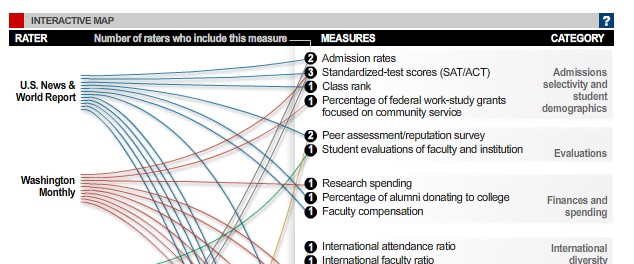
30 Ways to Rate a College – Measuring Stick – The Chronicle of Higher Education.

I like the graph here which displays all of the criteria prominent ranking systems use. Above is just a small bit of that image. But I think the bottom-line here is that it can be useful to look at many different sources, paying attention to their various distinctive criteria, when attempting to form an impression of a school.