Feeling old?

Feeling old?

One of my favorite links to look at every fall is the Beloit College Mindset List. Each year, the authors attempt to capture what makes the incoming class unique and some of the signature generational divisions we may confront as their older teachers/ mentors.  Some of my favorites from this year’s list:

3. The Green Giant has always been Shrek, not the big guy picking vegetables.

13. The KGB has never officially existed.

52. They have never been Saved by the Bell

53. Someone has always been asking “Was Iraq worth a war” [remember most were born in 1991, time of the First Gulf War]

68. Official racial classifications in South Africa have always been outlawed.

Perusing through previous years’ lists can make you even feel more out of touch with the new generation!

News and comment: Nigerian rumored to have been killed in China

The Wall Street Journal (clip below), CNN and a number of other sources are reporting that at least 100 Africans were involved in protests over immigration enforcement in China.  The spark was apparently the death of a Nigerian who was killed during an immigration raid.

China’s increasing ties with Africa is a subject that I am turning to in my current research.  But while my own research–and that of many others–tends to focus on China’s impact on Africa, we may neglect the potential for Africans to impact China.  This is a small reminder that there is a story to be told.  According to The Guardian, an estimated 20,000 Africans live in Guangzhou (the site of the unrest).

clipped from blogs.wsj.com

China has seen its fair share of anti-foreigner protests, from the Boxer Rebellion to the May Fourth movement, and, in more recent decades, more generically termed demonstrations against Americans, Africans, Japanese and the French.

Yet for all the expat grumbling about living in China, public protests by foreign residents are virtually unknown, perhaps tempered by the awareness that we are here by choice, live in relative comfort, and would likely achieve little more than a swift deportation.

But, reflecting the very different world in which some migrants live, Wednesday saw a rare protest by over 100 African residents of the southern city of Guangzhou.

According to Xinhua, at least one person died during a brawl that erupted after police raided a Guangzhou clothing market to check passports and visas.

blog it

Got to love my Swedish roots!

clipped from news.bbc.co.uk

Swedish pirates capture EU seat

Pirate Party supporters

Pirate Party supporters celebrate their win in the European elections

Sweden’s Pirate Party has won a seat in the European Parliament.

The group – which campaigned on reformation of copyright and patent law – secured 7.1% of the Swedish vote.

The result puts the Pirate Party in fifth place, behind the Social Democrats, Greens, Liberals and the Moderate Party.

Rickard Falkvinge, the party leader, told the BBC the win was “gigantic” and that they were now negotiating with four different EU Parliamentary groups.

“Last night, we gained political credibility,” said Mr Falkvinge.

blog it

Reminder of my Watsan days

An old Peace Corps friend posted this link on Facebook.  It reminded me of the work I did as a Peace Corps Volunteer in Ghana.  In many parts of rural Africa it is still normal to have no access to a toilet or latrine, and it is still normal to get water from unsafe sources.  It would be great to see more attention placed on this issue, but it tends to get ignored (as are children in much of Africa).

clipped from news.bbc.co.uk

Children sanitation alert issued

By Matt McGrath BBC science reporter

Burmese children in the slum area of Rangoon


In 2004, diarrhoea killed 1.8m people, WaterAid says

Millions of children’s lives are being put at risk each year because aid agencies and governments make wrong choices about health care priorities.

This is the conclusion of a new report from the charity WaterAid.

It says that diarrhoea caused by poor sanitation is killing many more children than HIV/Aids, tuberculosis and malaria combined.

The report says the global spending on HIV/Aids hugely outweighs the amounts spent on providing better sanitation.

blog it

Suspect in Wesleyan Shooting Apprehended

Many of you have heard of the recent tragedy here at Wesleyan. A student was shot and killed yesterday by a man who  — reportedly — harrassed her in the past. Fortunately, the suspect turned himself in this evening. Hopefully, the campus will be able to heal and recover from the tragedy.

I have only been here a year, but I can tell that such incidents are far from the norm for this university community. This is generally a safe place. I hope people will be able to feel that way again soon.

Suspect In Wesleyan Slaying Turns Himself In

By DAVID OWENS | The Hartford Courant

10:35 PM EDT, May 7, 2009

MIDDLETOWN – The massive manhunt for the man accused of killing a Wesleyan University junior is over.

Stephen Morgan, Suspected In Killing Of Wesleyan Student Johanna Justin-Jinich, Turns Himself In — Courant.com.

Some good news from Darfur

clipped from news.bbc.co.uk

On Thursday, the minister for humanitarian assistance, Haroun Lual Ruun, said Khartoum would allow those UN agencies and non-governmental organisations (NGOs) remaining in Darfur to “expand their existing operations”.

I think what we’re hearing… is that new NGOs with new names, new logos, if necessary, can come in
John Holmes UN humanitarian chief

“We have also agreed to further improve the NGOs operating environment by easing travel and visas restrictions, by reviewing the need for individual technical agreements for NGOs,” he said.

He was speaking during a visit to Sudan by UN humanitarian chief John Holmes and US envoy to Sudan Scott Gration.

Mr Holmes said that if trust was restored between the humanitarian community and Sudanese authorities, capacity lost after the expulsions could be recovered.

“I think what we’re hearing… is that new NGOs with new names, new logos, if necessary, can come in,” he was quoted as saying by Reuters news agency.

Displaced Sudanese women in Darfur, March 2009

blog it

Zuma has officially done it

So, Zuma has officially done it.  He is President of South Africa. It will be interesting to see what impact he has.  Will those who threatened to leave South Africa really leave?  Will he be successful with his populist agenda?

I was able to meet him at a lunch at UC Berkeley a little over a year ago where he — appropriately for his audience — made the argument that education would be a top priority.  Will it?

I also wonder about his impact on South Africa’s foreign policy. Mbeki had a clear agenda and goals with respect to the African region.  Will Zuma embrace the African Renaissance?  Will he improve on NEPAD, or let it falter?  Will he continue the agenda of engagement with other major developing countries, most notably India and Brazil?  I will definitely be watching!

clipped from news.bbc.co.uk

Zuma elected South African leader

Jacob Zuma


Jacob Zuma will be inaugurated on Saturday

The leader of South Africa’s African National Congress, Jacob Zuma, has been officially elected the country’s president by members of parliament.

He will be inaugurated on Saturday. The ANC won the general election in South Africa two weeks ago.

Mr Zuma’s government is expected to focus on the faltering economy, fighting crime, poverty and HIV/Aids.

He faced corruption charges, dropped on a technicality just before the polls. He always denied any wrongdoing.

blog it

FT.com / Africa – Kenyan women call for sex boycott

Not sure how I missed this story last week–though I’ve been quite busy between the normal end-of-the-semester routines, a Varieties of Democracy conference, celebrating my wife’s passing the CT bar, and preparing for a new baby…

Kenyan women call for sex boycott

By Parselelo Kantai in Nairobi

Published: May 1 2009 02:42 | Last updated: May 1 2009 02:42

Kenyan women’s organisations have called for a national sex boycott to force feuding male politicians in the coalition government to resolve differences.

The women said they were prepared to pay prostitutes to withhold their services for a week to make the campaign more effective.

The boycott was inspired by a feud between Mwai Kibaki, the president, and Raila Odinga, the prime minister, about who runs the government agenda in parliament. The women have sent emissaries to the wives of both men to encourage them to join the boycott which reflects intensifying public anger at the pace at which the coalition government is tackling the underlying causes of last year’s post- election crisis.

Kenya was gripped by violent ethnic protests that almost pitched the country into civil war and resulted in the deaths of some 1,500 people in the aftermath of disputed elections.

The coalition government formed to end the crisis has been beset by corruption scandals and internal feuding even as 10m Kenyans are threatened by starvation.

A survey showed that more than two-thirds of Kenyans no longer have confidence in the government.

“This is a call to mass action to protest poor leadership,” said Ms Patricia Nyaundi, executive director of the women’s organisation, FIDA. “The other option was to take to the streets with placards but we would have been clobbered by the police. So this is a protest from the safety of our homes.”

The boycott recalls Greek playwright’s Aristophanes’ comedy Lysistrata, about a sex boycott staged by Athenian women to end the Peloponnesian war.

“Our leaders are taking us in the wrong direction. Last year this feuding ended in violence. If this were to recur, it is the women and children who would bear the brunt,” Ms Nyaundi said

Some men interviewed for an opinion poll said they would go elsewhere for sex if their partners got involved.

NGOs involved intend to provide financial support during the boycott to sex workers, estimated at 7,000 in Nairobi’s central business district alone.

Copyright The Financial Times Limited 2009

FT.com / Africa – Kenyan women call for sex boycott.

From The Monkey Cage: Google’s New Data Search Tool

Google’s New Data Search Tool

With every passing month, access to social science data becomes easier.

Check out the launch of Google’s new data search tool here.

The Monkey Cage: Google’s New Data Search Tool.

See Here:

We just launched a new search feature that makes it easy to find and compare public data. So for example, when comparing Santa Clara county data to the national unemployment rate, it becomes clear not only that Santa Clara’s peak during 2002-2003 was really dramatic, but also that the recent increase is a bit more drastic than the national rate:


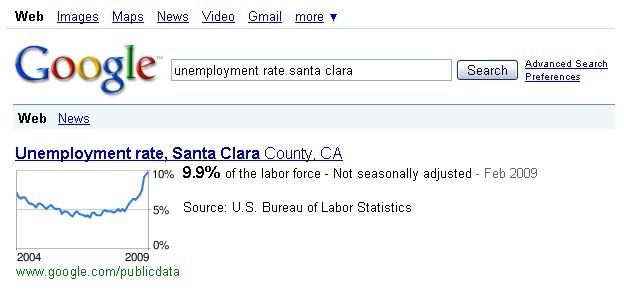
If you go to Google.com and type in [unemployment rate] or [population] followed by a U.S. state or county, you will see the most recent estimates:


Once you click the link, you’ll go to an interactive chart that lets you add and remove data for different geographical areas.

  blog it